

In Short
With the Digital Media Innovation degree you will develop a wide range of new digital skills that span social media, multimedia storytelling, information design, data and digital media studies, coding, and more to meet the needs of a flexible and changing global economy.
- Integrate academic work with community engagement to produce tangible, engaging, audience-aware products
- Produce engaging digital narratives using emerging tools, such as 3D printing, 360 degree video, augmented reality and creative multimedia coding
- Evaluate and critique the impacts of data on society and how data can be used to address issues such as social justice and inequality
DMI Expo


Program Overview
Are you ready to turn your creativity into a career? Digital Media Innovation is on the cutting edge of valuable creative and technical skills for a rapidly changing world. With the freedom to shape your own course of study, choosing classes that match your interests, you can create podcasts, design games, craft social media campaigns, analyze data, and even explore Generative AI and augmented reality. Along the way, you’ll tackle real-world projects and discover how to use technology to make a positive impact on society. DMI gives you the tools to stand out and succeed in your dream career.
One of the biggest strengths of Digital Media Innovation is that it allows you to customize your coursework across nine different departments, blending technology, creativity, and critical thinking. You’ll choose two of three specialized pathways, tailoring your education to your interests and career goals:
- Storytelling, Narrative, and Design – Learn how to craft compelling digital stories through podcasting, creative coding, web design, game design, and multimedia production.
- Data Studies – Develop data analysis, visualization, and research skills to better understand how data is shaping industries, from social media to business strategy.
- Digital Culture, Heritage, History, and Preservation – Explore how technology helps us record the present and interpret the past through digital humanities, media history, and interactive storytelling.
The DMI program culminates in a capstone project that demonstrates the changing ways we construct narratives using data and make technologies and practices that reconsider the human experience in a digital age. The capstone project is geared around student scholarship and professional development, providing an opportunity to develop professional portfolio pieces that will assist students in their careers.
This degree is typically awarded as a Bachelor of Science (BS). The Bachelor of Arts (BA) will be awarded if a student has demonstrated advanced intermediate proficiency in a world language.
Want to learn more? Watch these interview clips with Dr. Kyle Moody discussing the program.
Check out these YouTube videos to see what this program has to offer.
Experiential Opportunities

DMI Senior Capstone

International Class Collaboration

Visions

Study Abroad

Undergraduate Research Conference

Communication Law and Ethics

Introduction to Digital Humanities

Introduction to Social Media

Creative Coding

Data and Society
Curriculum and Other Information

Dr. J.J. Sylvia IV is an Associate Professor of Communications Media at Fitchburg State University and one of the co-founders of the Digital Media Innovation major as well as the Master's program in Applied Communication, Social Media. His teaching and research sit at the intersection of media philosophy, data ethics, and critical posthumanism, exploring how platforms, algorithms, and artificial intelligence are reshaping what it means to communicate, remember, and be human.
He teaches theory courses for the Communications Media major that also span the DMI program, such as Data and Society, Critical Making, and Communications Law and Ethics, where students engage with real-world questions about power, surveillance, and the social consequences of emerging technologies. His approach treats digital tools not as neutral instruments but as cultural forces that demand serious critical attention.
He uses an open pedagogy approach in the classroom, resulting in student projects and writing that frequently contribute to public-facing projects. In the last few years he has worked with his classes to publish three open education resources: The Data Renaissance, Introduction to Communication and Media Studies, and Critiquing AI in Media. His classes have also hosted a series of media archaeology exhibitions in Conlon Hall and contributed to digital historical walking tours on campus and in the community.
Dr. Sylvia’s recent research spans three projects. He recently completed a book on LiveJournal and Russian Disinformation, tracing how a social platform became an instrument of political manipulation. He is now writing a follow-up book on anti-fascist platform design, grounded in fieldwork on Italian resistance movements, and he is also pursuing rhetorical investigations of truth and democracy through immersive study in Greece, which has grown out of the Rhetoric in Greece study abroad class that leads every two years. He is the co-founder and co-Editor-in-Chief of the new Journal of Critical Posthumanisms, a peer-reviewed publication dedicated to emerging scholarship that "critically interrogate [s] the category of human as it relates to technology, ecology, and culture. The journal reconsiders the legacies of Western Civilization while foregrounding feminist, queer, decolonial, and disability-informed approaches."
In the classroom, Dr. Sylvia believes that understanding technology requires both hands-on creation and rigorous ethical inquiry. Students in his courses learn to ask who those tools serve, who they exclude, and what futures they make possible. That commitment to both making and questioning is at the heart of what the DMI major is designed to do.
Contact Dr. Sylvia at jsylvia3@fitchburgstate.edu or 978.665.3418.
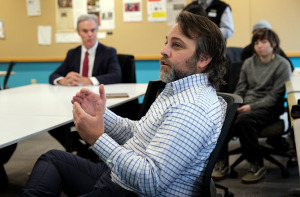
Dr. Kyle Moody is a Professor of Communications Media at Fitchburg State University and one of the co-founders of the Digital Media Innovation major as well as the Master's program in Applied Communication, Social Media. His teaching and research explores the ways that online communities of engaged users connect, form practical and value-based identities, and intersect through norms, rituals, and practices.
He teaches theory and production courses for the Communications Media major that also connect to the DMI program, such as Introduction to Social Media, and Social Media, Public Relations, and Advertising. These are client-based courses where students are expected to integrate theory into practice for the development of skills and portfolio materials. He works with students to make sure they see they are developing skills and workflow of technologies, and real-time beneficent and ethically-minded innovative practical applications. His clients have included the Worcester County Office of the District Attorney, Viewpoint Creative, Community Health Connections, and the Fitchburg Art Museum, as well as others.
Dr. Moody's research often connects him with studies of popular culture, including video games, television, streaming apps, and online news communities. His recent research has been published in Consumption Markets & Culture, along with his collection Hannibal for Dinner (co-edited with Dr. Nicholas Yanes).
Dr. Moody understands that technology and innovation must serve the publics from which they emerge. Students in his courses must integrate these technologies while remaining critical and cognizant of their impact, which is one of the tenets of the DMI major.
Contact Dr. Moody at kmoody4@fitchburgstate.edu or 978.665.3351.
- BS/BA, Digital Media Innovation, Communications Media - Program information from the University Catalog.
- Four-Year Plan of Study - Required and elective courses for program completion.
Students who complete this program will be able to:
- Explore topics in the humanities with critical thinking skills. This includes:
- Understanding history and how it’s studied.
- Using digital tools to study and recreate texts.
- Connecting ideas across different subjects.
- Analyzing texts with the help of technology.
- Using digital tools to set and evaluate research goals in subject-specific studies
- Think critically about information and technology.
- Combine academic learning with real-world projects to create work for specific audiences, including:
- Creating engaging digital stories using tools like 3D printing, 360-degree video, augmented reality, and multimedia coding.
- Developing social media strategies for outreach and content creation.
- Working respectfully with others from different backgrounds to meet community needs.
- Understand and evaluate how data affects society, including:
- How data can address problems like inequality and social justice.
- How data influences their personal life, studies, and future career.
- Using data effectively in the process of collecting, creating, analyzing and visualizing it.
- Solve real-world problems by:
- Applying knowledge to take responsible action on global issues.
- Using skills and methods from one situation to solve new and difficult challenges in creative ways.
- Digital content creators such as journalists, editors, or specialists
- Social/digital media managers
- Community engagement managers
- Digital content management
- Entry-level web developers
- Media positions in tech companies
- Digital media startups
- Data and analytics
- Digital project managers
- Multimedia producers
- News product development
- Still emerging jobs such as Digital Data Detective, Personal Memory Curator, and Augmented Reality Journey Builder
The DMI major grew out of a Digital Humanities (DH) faculty working group at Fitchburg State University, where faculty shared digital-based projects and tools they were using in their courses.
- Meta Quests 2 and 3
- Apple Vision Pro
- Apple iPad Pro with Lidar
- Revopoint Pop 2 3D Scanner
- Lilypad Arduino
- UNO Project Super Starter Kit (Arduino)
- Arduino MKR IoT Bundle
- Makey Makey
- FlashForge Finder 3D Printer
- Creality Hi 3D Printer
- GoPro Fusion 360 Degree Camera
- Flexible Mono eInk Display
- Mini Thermal Receipt Printer
- NFC Programmable Tags
- Insta360 Camera
- Meta Smart glasses
- NVIDIA Jetson Orin Nano Super Developer Kit (Local AI)
- DJI Avata 2 Drone with FPR (First Person View) headset
- DJI Osmo Pocket 3 Camera
- Zoom H3-VR Spatial Sound Recorder
- Xbox Kinect Camera
- Cricut Maker 4