
Report and Referral Form Links
- Refer a student of concern to the CARE Team
- Report an Incident or Code of Conduct Violation
- Report an Academic Integrity Violation
- Report an incident report of discrimination, sexual misconduct/harassment
We expect our students to act in a mature and responsible manner. Respect for the rights of others, openness to new and challenging ideas, civility and courtesy are examples of this expectation. The Student Conduct Process has been established to address alleged violations of the Student Code of Conduct. The goal of the Student Conduct System is to support the educational mission of the university by ensuring that an atmosphere of acceptance, curiosity and integrity is maintained on the campus.
The official method of communication by the Student Conduct and Student Affairs is via email to the student's email account.
Student Conduct is available to consult with students, faculty, and staff regarding the student conduct process, campus policies, interpretation of campus policies, student concerns (including classroom and behavioral issues) and other relevant areas. Please be advised that we are obligated to report certain information that may be disclosed to us. We reserve the right to share information with the Dean of Students and Chief Student Affairs Officer or other applicable offices that may have a legitimate educational interest or in cases of public safety.
Subject to Change Notice
The information on this website is for educational and informational purposes only. The information contained within the Student Conduct website is not intended to replace the Student Handbook or the Code of Conduct and Disciplinary Process Handbook.
The rules, regulations, policies, and procedures that appear in this handbook are updated on a regular basis. Like everything else on this website, they are published for informational purposes only, and they do not constitute a contract between the university and the student. Whether noted elsewhere on this site or in appropriate literature or not, the university reserves the right to change, eliminate, and add to any existing (and to introduce additional) rules, regulations, policies, fees and other charges, courses of study and academic requirements. Whenever it does so, the university will give as much advance notice as it considers feasible or appropriate, but it reserves the right in all cases to do so without notice.
Student Code of Conduct and Discipline Process Handbook
Preamble
Fitchburg State University expects its students to act in a manner that demonstrates personal responsibility and respect for the community. Respect for the rights of others, openness to new and challenging ideas, civility and courtesy are examples of this expectation. The student conduct process has been established to address alleged violations of the Student Code of Conduct (also referred to as Code of Conduct).
The Student Conduct Process has been established to address alleged violations of the Student Code of Conduct. The goal of the Code and the process is to support the educational mission of the university by ensuring that an atmosphere of respect, responsibility, and community is maintained on the campus.
Official communications are sent to the student's official Fitchburg State email account, regardless of whether they originate directly from the university or from an authorized university system (e.g., Maxient).
Student Conduct officers are available to consult with students, faculty, and staff regarding the student conduct process, campus policies, interpretation of campus policies, student concerns (including classroom and behavioral issues) and other relevant areas. Please be advised that we are obligated to report certain information that may be disclosed to us. We reserve the right to share information with the Dean of Students, Office of Equal Opportunity, University Police or other applicable offices that may have a legitimate educational interest or in cases of public safety.
Under M.G.L. c. 15A § 22, Fitchburg State University has the legal authority to establish policies necessary for the general business of the institution. The President of the University and Cabinet approved the Code of Conduct. The disciplinary process is administered by the Dean of Students and Chief Student Affairs Officer. The Dean has been charged with the administration of student conduct and the disciplinary process. The Dean shall coordinate recommendations from members of the university community regarding suggested revisions to the Code of Conduct. The Code shall be reviewed annually, with a comprehensive review occurring every 5 years. The Student Code of Conduct shall be interpreted and administered in a manner consistent with applicable federal and Massachusetts law and university policy.
- Fitchburg State University acknowledges that its students are granted constitutional rights including protected freedoms of association, assembly, and speech. Furthermore, the university upholds students' institutional rights to the responsible utilization of campus facilities and services, as well as the freedom of inquiry.
- Students at Fitchburg State University have a responsibility to act in a manner that promotes the wellbeing, respect, safety and security of all members of the university community.
- It is the responsibility of students to know and understand individual departmental policies as well as campus policies published in the Student Handbook and other university literature. These policies include, but are not limited to, policies stated in the Housing Agreement, Academic Integrity Policy, Acceptable Use of Technology Policy, EO Plan, Parking Policy, and Hazing Policy.
- The Student Code of Conduct is applicable to any student enrolled in or accepted for an academic program, regardless of credits carried, any individual attending classes at Fitchburg State, or any individual residing in campus housing at Fitchburg State University, or any recognized student organization. Generally, a student may not withdraw from the university with a pending conduct matter. If a student does withdraw with a pending conduct matter, either the case may proceed and be heard regardless of student participation, or the case may be held until such time the student seeks to readmit. Such decisions shall be made by the Dean of Students or designee.
- The Student Code of Conduct applies to student conduct, which occurs at Fitchburg State University or any of its grounds or at any university related activity regardless of location (away athletic contest for example). In addition, the student Code of Conduct applies when student conduct, wherever it occurs, calls into question a student’s suitability as a member of the Fitchburg State University community.
- Students who allegedly violate the Student Code of Conduct may become subject to disciplinary action.
- Students may be accountable to both civil authorities and to Fitchburg State University for conduct, which constitutes violations of local, state, federal laws, the Student Code of Conduct, and/or other university policies. On-campus student conduct procedures may be carried out prior to, simultaneously with, or following civil or criminal proceedings off campus at the discretion of the Dean of Students or designee. On campus student conduct proceedings will not be subject to challenge on the ground that civil or criminal charges involving the same incident have been dismissed or reduced. When a student has been charged with a civil or criminal violation(s) of law, Fitchburg State University will neither request nor agree to special consideration for the student solely because of their status as a student.
- The Student Code of Conduct and process are published in order to give students general notice of prohibited conduct. The Student Code of Conduct should be read broadly and is not designed to define misconduct in exhaustive terms. Questions or general inquiries should be made to the Dean of Students Office.
- The Student Code of Conduct and process are not to be regarded as contracts between students and Fitchburg State University. The university reserves the right to amend any provision of the student Code of Conduct and student conduct process at any time. Fitchburg State University will publish amendments on relevant websites.
- Students remain responsible for their conduct, even in circumstances where their behavior may have been impacted by alcohol, drugs, or physical or mental health conditions. The university may, at its discretion, take the above factors into consideration in determining appropriate institutional responses (including potential sanctions and support measures) should a student be found responsible for any violations of this Code of Conduct.
- A Student Conduct and/or Dean of Students Hold may be placed on a student’s academic record (or further action may be taken) when a student does not comply with a sanction or withdraws from the university prior to resolution of a student conduct matter. Students with a Hold may not be permitted to register, receive transcripts, receive a diploma, add or drop courses, register for university housing, or participate in other university activities.
The following conduct shall constitute violations of the Student Code of Conduct.
A. Academic Dishonesty
B. Personal Conduct
- 2.01 Obstruction or disruption (participating in or inciting others to participate in the disruption or obstruction) of teaching, administration, disciplinary system, the university or community or other university activities.
- 2.02 Conduct, regardless of where it occurs, that may be in violation of federal, state and/or local law or university policies that brings into question one’s suitability as a member of the university community, or has a detrimental effect on the reputation of the university.
- 2.03 Theft, attempted theft, or possession of stolen and/or unauthorized possession of property, resources, or services.
- 2.04 Damage and/or vandalism to university property, or the property of a member of the Fitchburg State community, and/or guests.
- 2.05 Misuse of university property, goods, and/or services.
- 2.06 Illegal gambling as defined in the Student Handbook is not permitted.
- 2.07 Unauthorized solicitation.
- 2.08 Unauthorized posting and/or distribution of flyers, bulletins or posters.
- 2.09 Failure to abide by the university Raffle Policy.
- 2.10 Failure to abide by the Good Neighbor Policy.
- 2.11 Public Exposure: including the intentional and public exposure of intimate body parts, as well as public urination, defecation, or engaging in public sexual acts that do not otherwise rise to a violation of sexual harassment policies.
- 2.12 Attempted or actual invasion of a person’s privacy.
- 2.13 Assisting another person in the commission, or attempted commission, of a violation of the Code of Conduct or a crime
- 2.14 Conduct, including comments, that constitutes a true threat.
- 2.15 Violation of published university policies.
- 2.16 Violation of Residence Life policies
C. Physical Safety and Environmental Health
- 3.01 Physical Assault, threat thereof, or any action which may subject another person to physical injury.
- 3.02 Harassment or bullying of another person which may: reasonably create a hostile environment, and/or infringe upon the rights of others, and/or interfere with the ability of a student to fully participate in the university.
- Please Note: In determining whether an act constitutes bullying, the Dean of Students or designee will consider the full context of any given incident, giving due consideration to the protection of the members of the university community, and the individual rights, freedom of speech, academic freedom and advocacy required by law. not every act that might be offensive to an individual or a group necessarily will be considered a violation of the Code of Conduct. In addition, any allegation of harassing behavior and/or bullying involving alleged discrimination and/or discriminatory harassment, which falls under the EO Plan, may be referred to and addressed through the university’s EO Plan.
- 3.03A Possession or use of weapons or weapon replicas, including explosives, fireworks or other dangerous items or substances. Violation of the Weapons Policy as noted in the Student Handbook
- 3.03B Possession or use of defensive sprays (including pepper spray) that has not been registered with the University Police Department
- 3.04A Creating a fire hazard or a situation which endangers others including false reports of a fire hazard.
- 3.04B Tampering with, damaging, disabling, or removing fire safety equipment and warning devices. This shall include covering a smoke detector.
- 3.04C Failure to follow fire safety procedures or instructions; or interfering with, obstructing, or filing false reports to Emergency Medical Services (EMS) or Police operations.
- 3.04D Failure to evacuate a building during a fire alarm within a reasonable timeframe.
- 3.05 Failure to abide by the university Hazing Policy.
- Please Note: The express or implied consent of the victim will not be a defense. Apathy and/or acquiescence in the presence of hazing are not neutral acts; they are violations of this code item.
- 3.06 Trespassing, forcible entry, or unauthorized entry and/or presence in buildings or property where posted or restricted, or attempts to commit the same. Reasonable notice of authority, or lack thereof, shall be given.
- 3.07 Animals are not permitted in campus buildings or on campus property, with the exception of: Service Animals, as defined by the Americans with Disabilities Act (ADA); and Assistance Animals (including Emotional Support Animals) approved through the University’s Disability Services Office or other designated office in accordance with the Fair Housing Act and Section 504 of the Rehabilitation Act. The University reserves the right to require the removal of any animal that is not under control, is not housebroken, poses a direct threat to the community, or otherwise fails to meet behavioral expectations, consistent with applicable state and federal law.
- 3.08 Failure to abide by university or state policy governing smoking in public buildings and/or University residence halls.
- 3.09 Failure to abide by established campus motor vehicle regulations.
- Please Note: Parking violations are administratively resolved through Parking Services. They may be referred for the student conduct process under the ‘Code’ when criteria is met under the parking policies, and all other resolutions through Parking Services have been exhausted.
- 3.10 Rollerblading, skateboarding, or operating a bike or motorized scooters in a building or in such a way outside that poses a risk and/or danger to self or others. Charging bikes and/or motorized scooters inside campus buildings is prohibited and they are not permitted in residence halls.
- 3.11 Playing sports in buildings and/or other locations that may pose a risk to property and/or the safety of others.
- 3.12 Possession of prohibited items in the residence halls as outlined in the Housing Agreement/Policies and Procedures.
- 3.13 Failure to maintain community health and living standards as outlined in the Housing Agreement/Policies and Procedures.
- 3.14 Failure to comply with university public health, and/or testing requirements, as stated in university policies, posted signage, and/or as stated by local Board of Health, State Dept. of Public Health, the Centers for Disease Control, and/or other Governmental agencies.
D. Personal Identification and Representation
- 4.01A Failure to present student identification and/or identify oneself upon request to a properly identified university official, when acting in their official capacity.
- 4.01B Falsification of one's identity or that of another, including but not limited to production, possession or distribution of fake IDs and/or One Cards.
- 4.02 Misrepresentation of a university official or campus organization or representing oneself as another. This includes the creation, alteration, distribution, or use of digital, synthetic, or manipulated content, identities, communications, or media for the purpose of impersonation, deception, harassment, fraud, intimidation, or to misrepresent another individual or the university.
- 4.03 Knowingly submitting false information for incorporation into any university record or document.
- 4.04 Failure to comply with a reasonable request of a university official while acting in their official capacity.
- 4.05 Unauthorized possession, duplication, tampering, or misuse of university property, including but not limited to records, electronic files, telecommunications systems, forms of identification, and keys.
- 4.06 Failure to abide by university technology, information security, acceptable use, computer, network, or other information technology policies.
- 4.07 Failure to register an event, comply with the Use of Space Policy, and/or campus guidelines for protests and demonstrations.
- Please Note: Consult with the Office of Student Engagement for event registration policies.
- 4.08 Failure to adhere to university guest policies.
- 4.09 Unauthorized use of the university name, logo, mascot or other university symbols.
E. Alcohol and Drugs
Failure to abide by university policies governing Alcohol
- 5.01A Violation of local, state or federal law, or university policies regarding alcohol.
- 5.01B The possession and/or use of alcoholic beverages is restricted to those persons age 21 and older. Students under the age of 21 and their guests, regardless of age, may not possess, use or distribute alcoholic beverages or be in attendance where alcohol is present (with the exception of university sponsored events where approved).
Please Note: The possession or presence of empty alcohol containers is prohibited in rooms where students are under the age of 21 and will be viewed as evidence of possession or consumption of alcoholic beverages. - 5.01C Possession of alcohol on campus over the approved limit as defined in the Student Handbook and/or Housing Policies.
- 5.01D Possession or use of common source alcohol containers and related paraphernalia (kegs, beer balls, funnels, etc.) are prohibited.
- 5.01E Open Containers and/or consumption of alcohol in public areas (bathrooms, hallways, lounges, outside etc.) is prohibited.
- 5.01F Providing alcohol to persons who are not of legal age is prohibited.
- 5.01G Participation in activities that could lead to use or abuse of alcohol or other substances (i.e. drinking games) as well as the use of funnels, beer bongs, and similar products is prohibited, with or without the actual presence of alcohol.
- 5.01H Driving under the influence of alcohol or other drugs is prohibited.
- Please Note: In most circumstances, the Dean of Students Office may not pursue formal disciplinary action against a student nor reporting party, when emergency services are contacted for an alcohol and/or drug situation. While the individuals involved may be required to meet with an administrator or complete follow up actions, they will not have a disciplinary history. Questions regarding this statement should be directed to the Dean of Students Office.
- Failure to abide by university policies governing marijuana
- Please Note: In 2016, Massachusetts legalized the growth, possession and personal recreational use of marijuana by adults 21 years of age and older. As a recipient of federal funding, however, Fitchburg State must comply with current federal drug laws that classify marijuana as a controlled substance and prohibit use and possession. Fitchburg State does not recognize medical marijuana cards as an exemption from the university’s prohibition.
- 5.02A Possession, use, and/or cultivation of marijuana, or being in the presence of marijuana, in university buildings including residence halls, and/or on university property is prohibited.
- 5.02B Possession and/or use of drug paraphernalia is prohibited.
- 5.02C Possession with intent to sell and/or distribute: The sale, attempted sale, distribution and/or attempted distribution of marijuana is prohibited.
- Please Note: Possession of an excessive quantity, scale, or other items relevant in distribution may constitute an allegation of distribution. Failure to abide by University policies governing other Drugs (not marijuana)
- 5.03A Possession and/or use of illegal drugs is prohibited.
- 5.03B Abuse of prescription drugs; possession and/or use of prescription drugs without a valid prescription is prohibited.
- 5.03C The sale, attempted sale, distribution and/or attempted distribution of illegal drugs and/or prescription drugs is prohibited.
- 5.04 Public intoxication on university property or at university sponsored activities is prohibited.
F. Discrimination and Sexual Violence Policy
Please Note: The EO Plan supersedes the Code of Conduct. Incidents that fall under the EO Plan are addressed through the complaint investigation and resolution procedures identified in the EO Plan. Other violations of the Code of Conduct discovered during a complaint investigation will be addressed through the appropriate policy.
G. Abuse of the Student Conduct System
- 7.01 Disruption or interference with the orderly conduct of a student conduct proceeding.
- 7.02 Falsification, distortion, or misrepresentation of information to an administrative hearing officer, student conduct staff member, or within the student conduct process.
- 7.03 Influencing or attempting to influence another person to commit an abuse of the student conduct system.
- 7.04 Attempting to discourage an individual’s proper participation in, or use of, the student conduct system.
- 7.05 Intimidation and/or retaliation of any person submitting a report, listed as a witness, and/or participating in a student conduct proceeding.
- 7.06 Institution of a student conduct proceeding based on a materially false claim or for the purpose of harassment, retaliation, or retribution.
- 7.07 Failure to comply with interim restrictions imposed by a University official.
- 7.08 Failure to comply with the sanction(s) imposed under the Code of Conduct or EOP.
- NOTE: The above list of violations is not intended to be exhaustive. A student may be subject to review for engaging in any listed or unlisted activity which appears to be in violation of what would be considered to believe reasonable behavior of the student community.
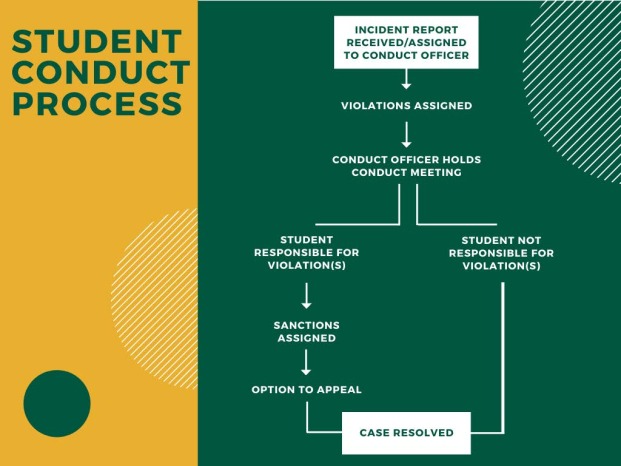
The following flow chart demonstrates the process of the conduct system:
A. Incident Report
Any member of the Fitchburg State University community may submit a written incident report documenting an alleged violation of policy. When possible, this report should be submitted within 60 calendar days of discovery of the alleged violation. The Dean of Students has the authority to extend this timeframe on a case by-case basis. Incident reports involving allegations of discrimination or sexual misconduct as defined within the EO Plan will be referred to the Office of Equal Opportunity; Anyone may submit a report directly via www.fitchburgstate.edu/report.
All incident reports will be referred to the Dean of Students or designee who may take one or more of the following actions within 10 business days:
- Dismiss the incident report if it lacks merit or is not submitted in a timely manner.
- Continue the matter pending further information and/or remand the matter for further administrative investigation.
- Schedule a mediation session, alternative dispute resolution meeting and/or informal resolution meeting.
- Refer the matter for a student conduct meeting, for formal resolution of the alleged violations.
- Impose interim restrictions and/or administrative protective measures, when there are sufficient facts to show that the student’s continued presence on campus endangers the physical safety or well-being of others or themselves, or disrupts the educational process of the University.
- Refer the complaint to the EO Officer or Title IX Coordinator for allegations that may fall under the EO plan.
B. Mediations and Student Conduct Meetings
- The objective of the mediation is for the accused student and the individual submitting the incident report to agree upon a mediated solution.
- The objective of an informal resolution meeting is for the accused student and a university official to agree upon a resolution, come to an agreement. If an agreement is reached, the case will end with no opportunity for appeal. All parties must agree to the outcome. If no agreement is reached, the case will be referred back to the Dean of Students or designee for additional review.
- Student Conduct conferences/hearings are formal meetings to determine a student’s responsibility for violating the Code and to determine sanctions for responsibility. Mediations, informal resolution meetings, or Student Conduct conferences/hearings will be conducted as soon as possible, but no sooner than two (2) business days (with the exception of the accused student waiving such right), nor more than fifteen (15) business days after the accused student has officially been notified (barring extenuating circumstances and/or in the event of an emergency situation). Accused students, with good reason, may request postponement of a meeting.
- Notice to appear for mediation, informal resolution meetings, or Student Conduct conferences/hearings will be delivered in writing to the accused student’s Fitchburg State email address.
- a. Official communication is sent through Maxient, which consists of a letter being sent to the student’s Fitchburg State email address. Notice is considered given when upon the sending of official correspondence. The student is required to log in to review the letter.
- b. If the student fails to log in to review the letter in a timely manner, the conduct officer shall send additional notices, which may include: email to the student’s Fitchburg State email address, hardcopy letter to the student’s residence hall location, or off-campus address via USPS.
- c. If the student fails to appear for the meeting, additional notice shall be sent to the student about their absence, and provide the student with 48 hours to respond. If the student fails to respond or provide a valid reason for their absence, the matter shall be heard in their absence.
- d. Notice for Student Conduct conferences/hearings shall include the following information:
- i. Time, Date, and Location of the meeting;
- ii. The specific alleged violations in the Code;
- iii. Nature of the Incident;
- iv. Office(s) or individual(s) that submitted the incident report;
- v. How to request to review the incident report;
- vi. Names and titles of any parties that may be present at the meeting, and their role in the meeting;
- vii. Where to find and/or link to the accused student’s rights as outlined in the Code.
- When multiple parties are involved in the same incident, the student conduct officer will decide whether cases will be heard together or separately.
- Mediations, informal resolution meetings, or Student Conduct conferences/hearings are not open to the public and are confidential in nature.
- Generally recording of any kind is strictly prohibited and potentially illegal. Any person found in violation of this rule, may be immediately removed from the meeting, and subject to disciplinary action for violation of Rule 7.01.
- a. If all parties in a meeting agree to record the meeting, then the university will officially record the meeting and a copy of the recording (and transcription if applicable) shall be saved to the file and made available to the accused student upon request within 45 days and in accordance with the university’s record release policies and federal law.
- Only evidence and/or information introduced at the student conduct conference/hearing will be considered in determining an accused student’s responsibility. Formal rules of process, procedure and/or technical rules of evidence, such as are applied to criminal or civil court proceedings, need not be used in Fitchburg State conduct proceedings. Generally, a student conduct conference/hearing will follow the following format.
- a. Introductions;
- b. Review of the Student Conduct Process;
- c. Review of the alleged violations;
- d. Review of Accused Student’s Rights;
- e. Opening Statement by Accused Student;
- f. Discussion of Incident and Question and Answer;
- g. Presentation of any witnesses (if applicable) and Question and Answer;
- h. Further discussion of incident;
- i. Closing Statement by Accused Student;
- j. Review of next steps in the process.
- Student conduct officers must be impartial. Student conduct officers may recuse themselves at any time if they feel that they cannot be impartial or remain unbiased. Questions of impartiality or bias should be directed to the Dean of Students.
- Determinations by Student Conduct officers are reached using the preponderance of the evidence standard, assessing if it is more likely than not that the respondent breached the Code.
- Participants in a Student Conduct conference/hearing, including the respondent, are required to follow the officer's rulings and maintain order. Individuals who cause disruptions or ignore these directives may be removed from the session and potentially face further referrals for conduct violations related to the disruption.
- Mediations, informal resolutions, and Student Conduct conferences/hearings may be recessed at any time provided they are reconvened within ten (10) business days (barring extenuating circumstances).
- There may be written and/or recorded summation or other type of record as determined by the student conduct officer, of all meetings. The record shall be the property of Fitchburg State University and maintained in the student’s file.
- A student may not be found to have violated the Code of Conduct solely because the student failed to appear for the conference/hearing. In all cases, the materials and information in support of the alleged violations shall be presented and considered, as the conference/hearing will be held in the absence of the student, should they fail to attend.
- A case may be reopened after the final decision is made if both of the following conditions are met:
- a. There is newly available evidence and/or information which could not reasonably have been discovered at the time of the original meeting.
- b. The request to reopen is made within one academic semester following the date of the original final decision. The Dean of Students has the authority to extend the time-frame on a case-by-case basis when there is reasonable information or extenuating circumstances to substantiate extending the time frame.
- When a student has also been criminally charged, the accused student has the right to refuse to incriminate themselves. All statements made in student conduct meetings or any other meeting, may be subject to subpoena.
- All procedural questions are subject to the final decision of the Dean of Students, or designee.
- If a student withdraws from the university prior to an open conduct matter being resolved, every attempt will be made to hear and conclude the case. The withdrawn student will be invited to participate accordingly. If they choose not to or fail to respond, the conduct officer will review the matter with the information available and come to a finding in accordance with this Code of Conduct.
- Student Conduct Officers are appointed by the Dean of Students or designee.
- An appointed Student Conduct Officer will be assigned to each conference/hearing.
- Appellate Officers are appointed by the Dean of Students.
- All Student Conduct Officers and Appellate Officers shall be required to attend annual training relative to the Code, conducting student conduct meetings, and relevant topics to include but not limited to student conduct practice, use of Maxient, restorative justice, implicit bias, ethics, laws and regulatory compliance, trauma informed interviewing etc. Appellate Officers shall attend additional training regarding the review of appeals and appeals procedures.
- In cases that could lead to an outcome of separation, more than one Student Conduct Officer will be assigned to the hearing.
A. Accused Student (Respondent) will be entitled to:
- Written notice of the allegation, as outlined in Part V, B.4.d.
- To be notified, at least 2 business days in advance, of all persons present at the meeting, and as to their role in the meeting.
- To be notified, at least 2 business days in advance, of any witnesses that will be called at the meeting and as to what they will provide information on.
- Opportunity to present their case, pose and/or raise any questions for consideration, question any witnesses, and present witnesses on their behalf.
- a. The accused student shall notify the student conduct officer at least 2 business days in advance as to any witnesses they plan to call and as to what they will provide information on. The Student Conduct Officer has the discretion to approve or deny witnesses based on relevancy to the case. Any disputes as to the calling of a witness shall be addressed to the Dean of Students.
- b. It shall be the responsibility of the accused student to notify their witnesses as to the time/date/and location of the meeting.
- c. Generally character witnesses are not accepted in person for meetings, but statements of character may be considered relevant to sanctioning.
- Not answer any questions or make any statements during a student conduct meeting. Such silence will not be used against the accused student; however, the outcome of the meeting will be based upon the information (or lack thereof) presented during the meeting.
- Work with an advisor throughout the conduct process. Only one advisor per accused student is allowed in the meeting. Advisors are not permitted to directly address the Student Conduct Officer and may not participate directly in any meeting. An advisor may consist of an attorney. When the accused student’s advisor is an attorney, the university may also have legal counsel present. Students will be required to inform the Student Conduct Officer of the attendance of an advisor prior to the conference/hearing.
- Be informed in writing within five (5) business days of the decision (barring any extenuating circumstances). In the event of delay, the Student Conduct Officer shall notify the student of the delay and the timeframe for receiving a notice of outcome.
- Opportunity to appeal the decision based on the appellate criteria outlined in the appeals section.
B. Complainants will be entitled to:
- Submit a ‘victim/survivor impact statement’ to explain the emotional, physical, financial, educational, and/or other impact(s) the incident has had on the alleged victim/survivor’s life. The accused student shall be able to review the statement. The statement will be part of the meeting record.
- Work with an advisor throughout the conduct process. Only one advisor per party is allowed in the meeting. Advisors are not permitted to address the student conduct officer and may not participate directly in the meeting.
- a. It is at the discretion of the Student Conduct Officer whether the victim/survivor will be called as a witness to the meeting, or permitted to directly read their ‘impact statement’ at the meeting.
- Notice of the decision consistent with applicable law.
Fitchburg State University upholds a philosophy of progressive sanctioning whenever appropriate. The conduct system and imposition of sanctions contribute to the teaching of appropriate individual and group behavior and foster the ethical development and personal integrity of students.
A. Sanctions Criteria and General Listing
- In determining a sanction, the responsible student’s present demeanor, past disciplinary history, the nature of the offense, the resulting severity of any damage, injury or harm and other factors may be considered.
- Any one or more of the following sanctions may be imposed, deferred, or held in abeyance by the student conduct officer or conduct board. A student shall not be considered in good conduct standing while they are on any type of conduct probationary status.
- a. Warning. Written notice that the behavior has violated the Code of Conduct. This may be considered part of the student conduct record in future disciplinary action.
- b. Restitution. Financial compensation for damages or costs may not exceed the actual value.
- c. University/educational service. Assignment of an appropriate project or attendance at an educational workshop that will benefit the University community, responsible student or others. Note that there is a financial fee associated with accessing some required educational sanctions
- d. Restriction. Denial of access to any campus facility, activity, class or program, or denial of student privileges.
- e. Disciplinary Probation. A period of time during which a student’s behavior is subject to close examination. A student is not considered in good conduct standing while on probation. Disciplinary Probation is set for a predetermined set of time. The student conduct officer will communicate to the student any specific parameters of the probation and/or expectations. Any student may apply to come off of probation before the expiration date to the Dean of Students.
- f. Relocation of Residence. Required assignment to another residence area.
- g. Loss of Residence. Removal from the residence halls. The expiration of the loss of residence period is no guarantee of readmittance to housing.
- h. Housing Probation. A delayed removal from university housing for a period up to two semesters. Any proven violation during this period may result in immediate removal from university housing for a specific period of time.
- i. Suspension. Removal from class/the University for a specified period of time ranging up to a maximum of two years. Suspended students must remove themselves from the campus totally. The expiration of the suspension period is no guarantee of readmittance. Suspended students are administratively withdrawn from the University with an effective date of the date of suspension or date of restriction, if applicable. The earlier date will be used. When the student is administratively withdrawn, it will be noted that the withdrawal is for conduct purposes. Generally, students administratively withdrawn for conduct purposes are not eligible for a refund and/or tuition and fees appeal. A suspended student must seek readmission no later than thirty (30) days prior to the expiration of the suspension. The Dean of Students or designee will make a determination based upon all available information whether readmission with or without conditions is possible. If not, the student will have the ability to file an appeal with regard to the continued suspension. The Dean of Students or designee reserves the right to grant exemptions regarding the specific conditions of a suspension.
- j. Student Organization Probation. A probationary period for a recognized student organization. Any proven violation during this period may result in immediate loss of recognition for a specified period of time.
- k. Loss of Recognition. A loss of recognition for a student organization, during which time it may not associate itself with the university by using the university name, facilities, and/or other rights and privileges of recognized student organizations. The expiration of the loss of recognition period is no guarantee of re-recognition.
- l. Dismissal. Permanent removal from the University. Dismissed students are administratively withdrawn from the University with an effective date of the date of suspension or date of restriction, if applicable. The earlier date will be used. When the student is administratively withdrawn, it will be noted that the withdrawal is for conduct purposes. Generally, students administratively withdrawn for conduct purposes are not eligible for a refund and/or tuition and fees appeal.
- m. Notification. Relevant parties or offices may be notified or contacted regarding a student’s behavior as appropriate and consistent with applicable law.
- n. Other Sanctions. Other sanctions may be imposed instead of or in addition to those specified above.
Please note: As the result of or in conjunction with a Student Conduct Hearing, students may be referred to appropriate offices, agencies, or services when deemed appropriate by the Dean of Students, or designee.
- Students may appeal the results of a Student Conduct conference/hearing, but informal resolution and mediation outcomes are final and cannot be appealed. Requests for an appeal must be submitted in writing to the Dean of Students Office electronically via the Appeal Form, or emailed to: studentaffairs@fitchburgstate.edu. The appeal request must be submitted by the student. Appeal requests not received in the established timeframe or that do not meet the established criteria will be rejected.
- Appeal requests will be considered based on the following criteria:
- a. procedural error within the conduct process that would substantially change the outcome of the hearing;
- b. lack of sufficient evidence to support the decision, new evidence or information that was not available at the time of the conference/hearing that would substantially alter the findings of fact and change the outcome of the conference/hearing;
- c. the sanction imposed is disproportionate or unreasonable.
- Students requesting to appeal a decision must do so in writing within five (5) business days of the date of the findings letter. The cutoff for appeals is 5 p.m. on the fifth business day. All requests are to be submitted to the Office of Student Affairs. The request should include the grounds for the appeal, all relevant information, and the desired outcome.
- Upon receipt of the request for an appeal letter, the Dean of Students or designee will review the appeal and record from the meeting. The Dean of Students will take one of the following actions.
- a. Dismiss the appeal if it does not meet the criteria and/or is not timely.
- b. Refer the matter to an appeals officer and/or appeals board.
- The appeals officer may determine there are no grounds for the appeal and uphold the decision or determine that the sanction is disproportionate and/or unreasonable and either alter it accordingly or return it to the prior level for further appropriate proceedings.
- Formal appeal meetings will be conducted following the same system as set forth for student conduct meetings.
- Appellate decisions are final.
- The Dean of Students, or designee may impose upon a student pending disciplinary action and/or in all cases where a student has been accused with and/or is undergoing criminal proceedings for any felony charge, immediate interim restrictions without prior notice whenever there are sufficient facts to show that the accused student’s continued presence on the campus endangers the physical safety or well-being of others, or themselves, or disrupts the educational process of the university.
- Interim restrictions may include, but are not limited to: restriction from class/ university and/or campus housing, assignment to alternate housing, limitation of access to designated housing facilities and/or campus facilities by time and location, restriction of communication with named individuals within the university community, and/or the requirement to secure advance authorization to engage in a specified activity.
- a. All restrictions from the university and/or removal from class and/or attendance at classes shall be subject to review by the Dean of Students.
- The Director of Residence Life or designee, may impose upon a student pending disciplinary action immediate residential restrictions without prior notice whenever there are sufficient facts to show that the accused student’s continued presence in the residence halls disrupts or potentially disrupts the residential community.
- Students wishing to appeal an interim restriction must first do so in writing, by submitting a written appeal to the Dean of Students Office. Upon receipt of the written appeal, the student shall have the opportunity to meet with the Dean of Students, or designee, to present their own version of the facts and to indicate why interim restrictions should not be imposed or should be modified. Following this meeting, the decision of the Director or designee will be final.
- Violations of interim restrictions may result in suspension or dismissal from Fitchburg State University.
- The Dean of Students, or designee, may take administrative action, irrespective of the student conduct process, except for in cases referred to the Title IX/Equal Opportunity Office, to provide protective measures and/or issue no contact orders.
- a. “No contact/communication” orders;
- b. escorts to ensure safety while moving between locations on campus;
- c. changes in academic or work schedules;
- d. alternative housing, dining, and/or office accommodations;
- e. restrictions from areas of campus;
- f. assistance in identifying an advocate to help secure additional assistance, such as off-campus and community advocacy, support and services; and/or
- A no contact/communication order is typically not meant to be a permanent solution to a conduct complaint or conflict. A formal meeting may be scheduled with the parties (separately if indicated) to review the order if necessary.
- A student with a disability who desires an accommodation in reference to a mediation, informal resolution meeting, student conduct meeting, appeal, must request an accommodation by following the procedure for requesting an accommodation through the Disability Services Office. The Disability Services Office will make a determination regarding the request and notify the appropriate parties. A student will not be considered to have a disability unless and until the student registers with the Disability Services Office.
Please contact the Disability Services Office for further information. - Reasonable accommodations depend upon the nature and severity of the individual’s documented disability and the setting for which the accommodations are requested. The university is not required to grant a requested accommodation that is unreasonable, ineffective, an undue burden or substantially alters a university program, service or practice. Reasonable accommodations will be provided as required by law.
- All students, irrespective of a disability, substance use issue, mental health condition, and/or any other condition are expected to adhere to the Code of Conduct and university policies. The American with Disabilities Act does not protect behaviors alleged to be a consequence of a disabling condition.
- Student Conduct files are deemed educational records and are maintained separately from any other academic or official file at the university by the Dean of Students or designee. Generally, information from the files is not released without the written consent of the student. However, certain information may be provided without a student’s prior consent to individuals within the university who have a legitimate legal and/or educational interest in obtaining it, and to individuals outside the university under certain circumstances. (Please refer to the federal Family Educational Rights and Privacy Act of 1974, as amended.)
- a. A student conduct file or disciplinary record is any record where the student has been found “responsible” for a violation of the Code of Conduct.
- b. Other records are maintained, but not considered student conduct files/ disciplinary records for reporting purposes.
- The sanctions of “Suspension” and “Dismissal” are not reported on the student’s transcript. When a student is suspended and/or dismissed, the student will be administratively withdrawn with an effective date of the suspension and/or dismissal, or the date of restriction (whichever date is earlier). When the student is administratively withdrawn, it will be noted that the withdrawal is for conduct purposes.
- A Student Conduct file is maintained chronologically by incident date and then by the accused student. A student may have more than one file. Generally, a Student Conduct file, including related documents, will be kept for seven (7) years from the final disposition of an incident. In cases of suspension or other special circumstances, at the discretion of the Dean of Students, files may be maintained longer. The Student Conduct file of a suspended and/or dismissed student is maintained permanently. All files and records are maintained in an electronic database.
- In situations involving both a respondent and a student who believes they were the victim of a student’s misconduct, the records of the process, if any, will be considered to be the educational records of both the accused student and the student who believes themselves, himself/herself to be the victim because the educational career and chances of success in the academic community of each may be impacted.
- The Dean of Students or designee has final authority regarding the inspection, review, or release of any student conduct file.
- Any questions of interpretation regarding the Code of Conduct shall be referred to the Dean of Students or designee for determination. The Dean of Students or designee’s determination is final.
- The Code of Conduct shall be reviewed annually by the Dean of Students or designee, and formally at least every five (5) years by an advisory group to the Dean of Students.
The following selected terms are defined in an effort to facilitate a more thorough understanding of the Code of Conduct. This list is not intended to be a complete list of all terms referenced in the Code of Conduct that might require interpretation or clarification. The Dean of Students or designee shall make the final determination on the definition of any term found in the Code of Conduct.
- Advisor: An individual who provides support and/or advice to a party in the conduct process. An advisor may be any individual, including an attorney. An advisor may observe, advise, or pass notes to the party, but in no way may ask questions, speak, or directly participate in the process.
- Agreement: The final agreement regarding violations and/or sanctions agreed upon between the hearing officer and the student.
- Appellate Officer: Any person or persons authorized by the Dean of Students and/or Vice President for Student Affairs, or designee to conduct a review of a decision reached by a student conduct officer.
- Bullying: The severe or repeated use by one or more students of a written, verbal, or electronic expression, or physical act or gesture, or any combination thereof, directed at another individual, that has the effect of: causing physical or emotional harm to the other student or damage to the other student’s property; placing the other student in reasonable fear of harm to themselves him/herself or damage to their his/her property; creating a hostile environment at school for the other student; infringing on the rights of other students on campus; materially and substantially altering the education process or the orderly operation of the university. If the bullying is directed at those associated, or perceived to be associated with a protected class, it may be a violation of the University Policy Against Discrimination, Discriminatory Harassment, and Retaliation (included in the Equal Opportunity Diversity and Affirmative Action Plan) and/or a violation of the University’s Sexual Violence Policy. Violations of those policies may be addressed under the EO Investigation and Resolution Procedures.
- Business Day: Any day, Monday through Friday, that the university is open.
- Complainant: Any person, office, or the university itself, who submits an allegation that a student violated the Code of Conduct.
- Class Day: A day when classes are in session.
- Day: A calendar day.
- Designee: A staff or faculty member who is responsible for implementing the student conduct process or administering the student conduct system, in part or in whole, at the direction of the Dean of Students or other university official.
- Dean of Students: The person in Student Affairs, designated by the president, to be responsible for the overall coordination of the university student conduct system, including the development of policies, procedures, and education training programs. The Director may serve as a student conduct officer and/or appellate officer.
- Dean of Students Hold: An administrative hold placed on a student’s account by the Dean of Students for purposes related to the functions of the conduct system, EO Plan, and/or other administrative policies/purposes. Also referred to as a Dean of Students Hold.
- Student Conduct Hold: An administrative hold placed on a student’s record when they do not respond to the request of a university official to attend an administrative hearing, has not completed a disciplinary sanction, or has withdrawn or left the university while a conduct matter is pending.
- Equal Opportunity, Diversity and Affirmative Action Plan (‘EO/AA Plan’): The Massachusetts State Universities Plan that includes the Policy of Nondiscrimination and the Title IX Sexual Harassment Policy. The document also includes the complaint investigation and resolution procedures.
- Instructor: Any faculty member, teaching assistant, graduate assistants or any other person authorized by the university to provide educational services (e.g., teaching, research, or academic advising).
- Interim Restriction: Restrictions, which may be immediate, taken against a student prior to an administrative hearing on the student’s alleged violation.
- Guest: A non-student who is an associate of a student.
- Harassment: This means the severe or repeated use by one or more students of a written, verbal, or electronic expression, or a physical act or gesture, or any combination thereof, directed at another individual that has the effect of: causing physical or emotional harm to the other student or damage to the other student’s property; placing the other student in reasonable fear of harm to themselves him/herself or damage to their his/her property; creating a hostile environment at school for the other student; infringing on the rights of other students on campus; materially and substantially altering the education process or orderly operations of the university.
- Informal Resolution: A type of mediation under the student conduct process, which is offered on a discretionary basis. A meeting between a hearing officer and a student to discuss an incident that occurred or a complaint that was filed, which serves the purpose of determining if an agreement can be reached in lieu of an administrative hearing.
- Intoxication: An allegation that a person is having physical or mental control markedly diminished by the effects of alcohol or drugs.
- May: This is used in the permissive sense.
- Member of the University Community: Includes any person who is a student, instructor, or university staff member; any person working for the university, either directly or indirectly (e.g., private enterprise on campus); or any person who resides on university premises. The Dean of Students shall determine a person’s status in a particular situation.
- Mediation: The objective of the mediation is for the accused student and the individual submitting the incident report to agree upon a mediated solution.
- Policy: The written regulations, standards, and student conduct expectations adopted by the university. These may be amended, modified, or replaced from time to time.
- Registered Student Organization: A group or associate of students which has complied with the other student organizations requirements prescribed by the Office of Student Development and by SGA.
- Respondent/Responding Student: Any student accused of violating the student Code of Conduct. (also referred to as accused student)
- Sanction: A requirement a student must abide by or complete when found responsible for violating the student Code of Conduct.
- Shall and Will: These are used in the imperative sense.
- Student: A student is defined as any person who has been admitted to, registered for, enrolled in, or is currently attending any course or program conducted by the University. This definition further includes any admitted individual present on university or university-affiliated property for any reason related to their enrollment or registration.
- Student Conduct Record: The printed/written/electronic file which may include but is not limited to incident report(s), correspondence, academic transcript, witness statements, and student conduct history.
- Student Conduct Officer: A university staff member who is authorized to determine the appropriate resolution of an alleged violation of the student Code of Conduct, and/or to impose sanctions or affect other remedies as appropriate. A hearing officer is also vested with the authority to, among other duties, investigate a complaint of an alleged violation of the Code of Conduct, decline to pursue a complaint, refer identified disputants to mediation or other appropriate resources.
- Student Organization: An association or group of persons that has complied with the formal requirements for university recognition or is recognized by the university.
- University: Fitchburg State University
- University Document: Means any University record, written communication, or form.
- University Official: Any person employed by the university to perform administrative, instructional, or other professional duties.
- University premises: All land, buildings, facilities, and other property in the possession of or owned, used, or controlled by the university, either solely or in conjunction with another entity.
- University Sponsored Activities: Any activity, on or off the University premises, which is initiated, aided, authorized, or supervised by the University, including any student, and/or registered student organization.
- Victim/Survivor: A person who is harmed, injured, or otherwise directly impacted as the result of a crime, accident, violation of the code, or other event or action. Witness: Any person with knowledge of a student’s alleged violation of the student Code of Conduct.