
About the Clery Act
The Clery Act is a consumer protection law that aims to provide transparency around campus crime, policies, and statistics. The Jeanne Clery Campus Safety Act, signed in 1990, reauthorized in 2024, is a federal statute codified at 20 U.S.C. § 1092(f), with implementing regulations in the U.S. Code of Federal Regulations at 34 C.F.R. 668.46.
The Clery Act requires all colleges and universities that participate in federal financial aid programs to keep and disclose information about crime on and near their respective campuses. Compliance is monitored by the United States Department of Education. The law is named after Jeanne Clery, a 19-year-old Lehigh University student who was raped and murdered in her campus hall of residence in 1986.
Annual Security and Fire Safety Report (ASFSR)
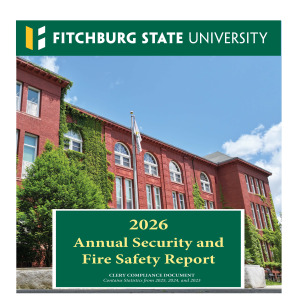
The Annual Security and Fire Safety Report, often referred to as the Clery Report, includes statistics about crimes and other security incidents reported to campus security authorities in the past three years.
The report also outlines policies, practice and resources related to campus security, crime reporting, alcohol and drug use, victim assistance programs, student discipline, community safety alerts, crime prevention, access to campus facilities/properties and personal safety tips. Below are the past six Annual Security and Fire Safety Reports published by Fitchburg State University.
Fitchburg State University’s Clery Crime Logs and Fire Logs are available for viewing at the University Police Station, 32 Clinton Street, Fitchburg.
Information concerning sex offenders may be accessed on our Sex Offender Registry Information page.
Clery Geography
Although the Clery Act does not require institutions to provide a map to show their campus and non-campus buildings, campus property or public property areas, Fitchburg State University chooses to provide one in their annual security report to help the campus community better understand where reported crimes occurred. Our maps are useful to help identify the buildings and property that make up the Fitchburg State University’s Clery Act geography, and to pinpoint the patrol jurisdiction of the Fitchburg State University Police Department.
Fitchburg State University Alert (FSU Alert)
Fitchburg State Alert will enable the university to notify you of important campus announcements including, such as emergencies, and campus closures. Fitchburg State Alert is set up to send notifications to your Fitchburg State University email by default. Mobile phones, landlines, and additional email addresses must be entered by the user. Login with your University Credentials to begin.
What is a Timely Warning (Also Known as an FSU Crime Alert)?
The Clery Act requires institutions to alert the campus community to certain crimes in a manner that is timely and will aid in the prevention of similar crimes. Although the Clery Act doesn’t define “timely,” the intent of a warning regarding a criminal incident(s) is to enable people to protect themselves. Warnings will be issued as soon as pertinent information is available. The warning will contain information about the type of criminal incident that has occurred.
A timely warning will be decided on a case-by-case basis in light of all the facts surrounding a crime, including factors such as the following:
- The nature of the crime
- The continuing danger to the campus community
- The possible risk of compromising law enforcement efforts
Fitchburg State Alert is set up to send notifications to your Fitchburg State University email by default. Mobile phones, landlines, and additional email addresses must be entered by the user. Login with your University Credentials to begin.
Hazing
Hazing is prohibited at Fitchburg State University and is defined as any conduct that willfully or recklessly endangers the physical or mental health of any person during initiation into a group, regardless of consent. The university requires immediate reporting of any known hazing acts to officials like the Dean of Students or University Police. Information on Hazing, how to report incidents of hazing, or view our Campus Hazing Transparency Report can be found on the Hazing page.
Campus Security Authority
Campus Security Authority is a Clery-specific term that encompasses four groups of individuals and organizations associated with the institution. A campus police department or a campus security department of an institution. Any individual or individuals who have responsibility for campus security but who do not constitute a campus police department or a campus security department. Any individual or organization specified in an institution’s statement of campus security policy as an individual or organization to which students and employees should report criminal offenses. An official of an institution who has significant responsibility for student and campus activities, including, but limited to, student housing, student discipline and campus judicial proceedings. An official is defined as any person who has the authority and the duty to take action or respond to particular issues on behalf of the institution.
Campus Security Authority Incident Report Form
Archived ASFSR Reports
Annual Security and Fire Safety Reports which were created before April 26, 2027, shall be deemed archived for reference, research, or recordkeeping purposes, without meeting WCAG 2.1 accessibility standards.
Frequently Asked Questions
A: Under the Clery Act, designated Campus Security Authorities (CSAs) are legally required to report allegations of Clery Act crimes. At Fitchburg State University, CSAs are identified by their institutional roles and titles and include:
- Law Enforcement & Security Personnel: Sworn officers and dispatchers of the Fitchburg State University Police Department.
- Campus Safety Officials: Personnel with designated safety responsibilities, such as building monitors, event safety staff, and parking enforcement staff.
- Officials with Significant Responsibility for Student and Campus Activities:
- Executive Director of Student Affairs and Campus Life
- Dean of Students
- Director and Associate/Assistant Directors of Residence Life
- Resident Assistants (RAs) and Community Advisors (CAs)
- Director of Athletics, Assistant Directors, Head Coaches, and Assistant Coaches
- Director of Student Engagement and Campus Center
- Title IX Coordinator and Equal Opportunity Officer
- Faculty and Staff Advisors to recognized student organizations
Note: Licensed mental health counselors in Counseling Services and pastoral counselors acting strictly within their professional scope are exempt from Clery CSA reporting requirements.
A: Campus Security Authorities (CSAs) at Fitchburg State University must immediately forward any report of a Clery Act crime occurring within Clery geography to the Fitchburg State University Police Department or submit a CSA Incident Report Form.
CSAs are responsible for reporting the facts as provided to them; they are not required or permitted to investigate incidents or determine whether a crime actually took place.
A: Key safety policies, emergency procedures, and crime data are published in Fitchburg State University’s Annual Security and Fire Safety Report (ASFSR). Published annually by October 1st in compliance with federal law, the ASFSR includes:
- Clery Act crime statistics for the three most recent calendar years.
- Campus security, access, and emergency response policies.
- Alcohol, drug, and sexual misconduct prevention resources.
The current report is accessible on the Fitchburg State University Police website above, and physical copies can be requested in person at the University Police Station (32 Clinton Street, Fitchburg, MA).
A: Notifications sent via email, SMS, or phone calls are issued through the FSU Alert system and the RAVE Guardian mobile app. Depending on the situation, one of two federally mandated alerts is sent:
- Timely Warnings Notification: Issued when a Clery Act crime occurring within Fitchburg State’s Clery geography is reported and determined to pose a serious or ongoing threat to students or employees.
- Emergency Notifications: Issued immediately upon confirmation of a significant emergency or dangerous situation (e.g., active safety threat, severe weather, hazardous materials incident) threatening the immediate health or safety of the campus community.
A: Clery crime statistics represent incidents of specific federally defined offenses that occurred within Fitchburg State University’s Clery geography and were reported to a Campus Security Authority (CSA) or local law enforcement. Statistics are tracked across four main categories:
- Primary Offenses: Murder, non-negligent manslaughter, negligent manslaughter, sexual assault (rape, fondling, incest, statutory rape), robbery, aggravated assault, burglary, motor vehicle theft, and arson.
- VAWA Offenses: Domestic violence, dating violence, and stalking.
- Hate Crimes: Any primary offense, plus larceny-theft, simple assault, intimidation, or property destruction/vandalism motivated by bias.
- Arrests and Disciplinary Referrals: Violations of liquor laws, drug abuse laws, and weapons laws.
A: Yes. Under the Violence Against Women Act (VAWA) amendments to the Clery Act, Fitchburg State University tracks statistics for sexual assault, dating violence, domestic violence, and stalking.
Fitchburg State offers specialized victim assistance, interim protective measures, and fair disciplinary processes coordinated through the Title IX Coordinator, the Dean of Students, and the Fitchburg State University Police Department. Full procedural rights and confidential reporting options are detailed in the Annual Security and Fire Safety Report.