

Recently, a new volume of educational research titled, “The Impacts of Censorship - Volume 2: The Voices and Experiences of Classroom Teachers” was officially released. While publishing research is significant in any academic career, for the community at Fitchburg State University, the book represents something far more personal: the culmination of a four-year professional evolution between a professor and her student.
Associate Professor of English Studies Katharine Covino serves as one of the volume’s editors. However, the heart of her contribution lies in a 12-page article she co-authored with Caitlin Moriarty, a 2025 Fitchburg State graduate. The piece, which began as an undergraduate Honors Thesis, has now transitioned into a peer-reviewed resource for English teachers nationwide.
Their collaboration offers a rare glimpse into the power of academic mentorship, proving that the boundary between student and colleague is more fluid than many realize.
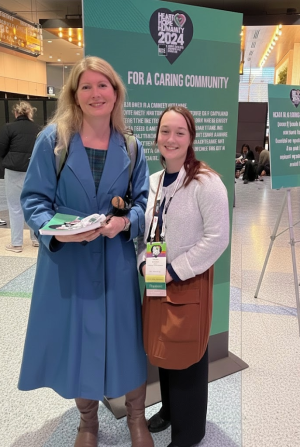
The partnership between Covino and Moriarty did not begin with a research proposal, but with a series of shared experiences in the classroom. Over four years, Covino worked with Moriarty in nearly every capacity possible: as a professor in multiple courses, a practicum supervisor, and a mentor for Moriarty as a teaching intern in the First Year Experience (FYE) program.
"I’ve always treated Caitlin like a master’s student," said Covino. "I think that holding high expectations, but providing support to students as they meet those expectations, is part of the job. All the time I’ve known her, I’ve challenged her, and she’s definitely ready for doctoral work."
For Moriarty, who entered college as an "independent self-starter," the impact of having a seasoned professional recognize her potential early in her college career was transformative.
"To have somebody who has been in the field who believes in you and is there for you is so valuable," said Moriarty. "Having a mentor is the most valuable part of going to college."
When it came time for Moriarty to design her honors thesis, the duo chose to tackle one of the most contentious issues in modern American schooling: book censorship.
As a scholar in the field and a longtime member of the National Council of Teachers of English (NCTE) Committee Against Censorship, Covino saw an opportunity for Moriarty to contribute on-the-ground data to a field that was increasingly under pressure.
"We designed the study and Caitlin carried out the research and collected the data," said Covino. "The field of censorship right now in many ways is a little bit bleak, but our findings were hopeful."
While their initial lens was defensive—focusing on how teachers could protect themselves—the data led them to a more proactive conclusion. They discovered that the most effective way to navigate censorship was not through isolation, but through allyship.
"The takeaway is that allyship is really important," said Covino. "Allyship with parents and community members, allyship with students, allyship with administrators. Allyship offers a way to navigate the challenges posed by censorship."
The transition from a student project to a professional publication was catalyzed by a trip to the NCTE Annual Conference in Boston in November 2024. Presenting "Censorship and Allyship" to a room of veteran educators, Moriarty found herself no longer just a student, but a contributor to the national discourse.
The reception was immediate. Members of the NCTE council, impressed by the rigor of the undergraduate research, invited Covino and Moriarty to contribute to a special volume.
"There was immediate feedback from Dr. Covino that we needed to present it there, because it was so meaningful and such an opportunity," said Moriarty. "Once I was able to meet people who were interested in the issues of censorship on that committee, they informed us during that session that they would be interested in doing a special issue like this on censorship, including some of the research that was in there that day."
The resulting 12-page published article provides English teachers with a model of hopeful action steps. It offers practical strategies for building community support around diverse literature.
For Moriarty, seeing her name in print was "surreal." Now pursuing a master’s in Education for Pedagogy and Learning with a concentration in Teaching English as a Second Language, she finds the publication has already changed her professional trajectory.
“This is not a thing you normally get to talk about. Now when I’m going into a job interview and meeting other teachers, it always kind of comes up without me even trying,” said Moriarty, who earned a bachelor’s in English for secondary education. “It’s immediately a point of interest. I’m so proud of the work that has come out of it.”
Covino’s commitment to researching, presenting, and publishing with students—having previously worked with others like Natalie Chase, Hannah Britten, Matthew McCann, and current student Matthew Gill—is rooted in a philosophy of giving back.
"I think mentorship is paying it forward," said Covino. "When Caitlin is a veteran teacher and there’s a new teacher who she has a relationship with, she’ll then take the initiative to be the mentor herself."
As the volume recently hits the shelves of libraries and the desks of educators, it serves as a testament to the fact that some of the most impactful research comes from the collaborative bond between a dedicated professor and a student who was given the tools to lead.
"English teachers everywhere will benefit from the work we did," said Covino. "And that is really gratifying."