
Critical and Creative Thinking Across the Disciplines
Abolitionist Park


Abolitionist Park
Photo of park
"We are students at Fitchburg State University enrolled in the Honors Program. As part of the program, we take a course entitled Honors 1020, Current Events and Service Learning. This page is the culmination of the Honors 1020 coursework taught by Dr. Danette Day in the Spring semester of 2021."
"The Fitchburg Abolitionist Park celebrates the men and women of Fitchburg who fought for the abolition of slavery. It serves to educate anyone who visits the park about the Abolitionist Movement specifically within their own community of Fitchburg. This park will honor diversity, equality, freedom and be a space to bring people of all backgrounds together to celebrate these things."
Want to get involved? The project is seeking collegial collaborations to complete Phase 3 of the park. Phase 3 is the creation and installation of an interpretive display panel using AR to teach about the Abolitionist history in Fitchburg. Additionally, there is need for collegial support for ongoing program development (i.e. music, art, theater) in the park to engage community and to help sustain the park's livelihood.
Communication Law and Ethics Discussion Guides
Series of one-sheets created for the Society of Philosophers in America (SOPHIA) of Worcester County chapter by students in the Communication Law and Ethics course and edited by Dr. J.J. Sylvia IV and Dr. Kyle Moody.
Supported by SOPHIA and the Douglas and Isabelle Crocker Center for Civic Engagement
- Ethics of Online Catfishing (PDF)
- The Ethics of Fake News (PDF)
- The Ethics of Political Advertising (PDF)
- The Ethics of Targeted Advertisements (PDF)
- The First Amendment and Censorship (PDF)
"Gender and Sexuality: LGBTQ Issues and Themes"
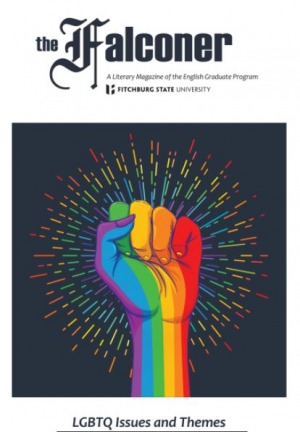
Undergraduate and graduate students in Dr. Wendy Keyser's LGBT Issues and Literature course submitted writing to Fitchburg State's The Falconer: A Literary Magazine of the English Graduate Program (PDF).
"The purpose of this issue is to share academic work on issues of gender, sexuality, and LGBTQ identity. Some readers may have begun to wonder 'what does it mean to be transgender?' and 'how is gender or sexuality non-binary?'. For these readers, the pieces in this volume are approachable enough to clarify answers to such questions, without use of jargon and with attention to the experiences of real people. Other readers may be deeply familiar with LGBTQ topics and seek deeper explorations of these topics, with interest in how academic thought applies these ideas to popular culture, literature, and researched aspects of society. These readers, too, will be rewarded by the depth to which the pieces in this volume explore new territory."
Supported by Fitchburg State University English Studies
The Art of Puppetry
Students created their own masks in Sally Moore's ART 2150 The Art of Puppetry. In this course, along with masks, students learn how to construct shadow puppets, hand and rod puppets, and marionettes as well as put on performances of folk tales from various parts of the world.


Concert Choir at Fitchburg Art Museum's Art in Bloom Exhibit
The Fitchburg State Concert Choir performs at the Fitchburg Art Museum as part of their Art in Bloom exhibit.


Busts in Ceramics
Students in Ceramics II class put some final touches on their busts.


Projects in Intro to Music Technology
Students in Intro to Music Technology work on their projects, focusing on acoustics, hardware operation, music theory, notation, and composition skills through instructional software and on creating, recording, and editing sounds with digital audio applications.


Kora Performer Visits Medieval Africa Literature and Heritage and World Music
John Hughes, an internationally-renowned composer, musician, and educator, visits and performs for the Medieval Africa Literature and Heritage and World Music classes.


Working in the Robert E. Cormier Archive
Literature for Young Adults students read Fitchburg State University alumni Robert Cormier’s novel The Chocolate War, dig deeper into the story by working collaboratively with their classmates in the Robert E. Cormier Archive, and give final presentations.

Researching in the Archives
with their classmates

Giving Final Presentations
on information they found in the archives
Biology and Chemistry

Invertebrates in General Biology II - Worms
Lab students study invertebrate anatomy of worms.

Invertebrates in General Biology II - Lobster
Lab students study invertebrate anatomy of lobsters.

Experiments in Organic Chemistry II
Lab students perform experiments extracting lycopene from two brands of tomato paste.

Organic Chemistry II
Lab students perform experiments in the lab.