
Fitchburg State hosts at least one contest every year. Each spring high school students from around the region come to campus to compete in the Elizabeth Haskins Contest. In addition, often the Mathematics Departments host the American Mathematical competition in the fall.
Elizabeth Haskins Contest Information
Every year in the spring, the Mathematics Department hosts the Elizabeth Haskins Contest for High School students in the region surrounding Fitchburg. The contest is a 50-question, 90-minute multiple choice test covering a variety of high-school level mathematics problems.
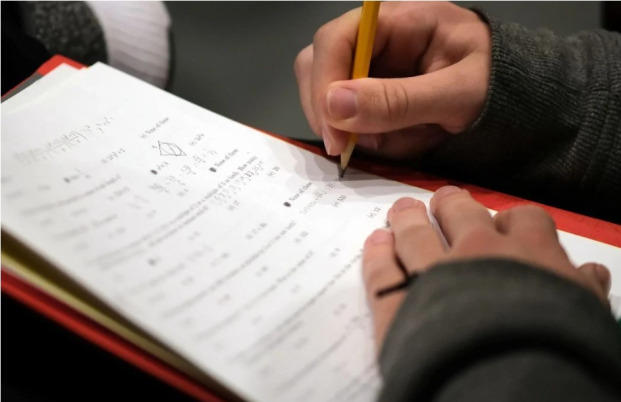
The contest is open to high school sophomores, juniors and seniors in regional high schools. The top three in each grade are given awards as well as a number given honorable mention. The problems come from algebra, geometry, probability and general mathematical solving techniques. No calculus is needed for the problems and no calculators are allowed. Generally the ways that questions are asked do not require complicated arithmetic.
Sample Problems for the Haskins Contest
Here's a sample of problems from recent contests.
-
The expression \(\sqrt{\dfrac{4}{3}} - \sqrt{\dfrac{3}{4}}\) is equal to:
(a) \(\dfrac{\sqrt{3}}{6}\) (b) \(-\dfrac{\sqrt{3}}{6}\) (c) \(0\) (d) \(4\) (e) None of these. -
The surface area of one cube is twice that of another cube. To the nearest 0.1 what is the ratio of the edge length of the larger cube to that of the smaller cube?
(a) \(1.3\) (b) \(1.4\) (c) \(1.5\) (d) \(1.7\) (e) \(2.0\) -
A bag contains two red beads and two green beads. You reach into the bag and pull out a bead, replacing it with a red bead regardless of the color you pulled out. What is the probability that all beads in the bag are red after three or fewer such replacements?
(a) \(\dfrac{1}{8}\) (b) \(\dfrac{5}{32}\) (c) \(\dfrac{9}{32}\) (d) \(\dfrac{3}{8}\) (e) \(\dfrac{7}{16}\) -
A hockey goalie has saved 122 out of 148 shots so far this season. How many consecutive shots does she need to save to raise her save percentage to 90.0%?
(a) \(82\) (b) \(102\) (c) \(112\) (d) \(132\) (e) \(142\) -
One solution to the equation \(2x^3-3x^2-8x=3\) is \(-1\). What are the other solutions?
(a) \(3\) and \(-\frac{1}{2}\) (b) \(-3\) and \(\frac{1}{2}\) (c) \(-\frac{1}{2}\) and \(3\) (d) \(\frac{1}{2}\) and \(3\) (e) None. -
Let \(n\) be a positive integer. The number \(n\) is abundant if the sum of its positive divisors is greater than or equal to \(2n\). For example, if \(n = 12\), then the sum of its factors is \(1 + 2 + 3 + 4 + 6 + 12 ≥ 2(12)\). Hence, 12 is abundant. An abundant integer which cannot be written as the sum of some subset of its proper divisors is called weird. For example, \(1 + 2 + 3 + 6 = 12\). Hence, 12 is abundant but not weird.
Which of the three integers 6, 30, 70 is weird?
(a) \(6\) only (b) \(30\) only (c) \(70\) only (d) \(6\) and \(30\) (e) \(30\) and \(70\) -
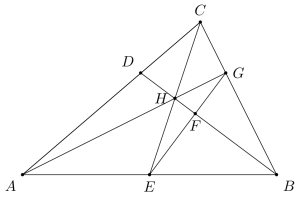
What is the total number of triangles in the figure below?
(a) \(7\) (b) \(10\) (c) \(18\) (d) \(21\) (e) \(24\)
General Information about the Contest
The contest is generally on a Friday in the spring and the date will be announced in the fall to give schools and teachers time to schedule. The events for the day are:
- Contest (90 minutes)
- Lunch (about 45 minutes)
- Award Ceremony
- Solution Session (about 45 minutes)
If you are interested in participating in the contest, as a mathematics teacher, email math-chair@fitchburgstate.edu. If you are a student, ask your math teacher to email.
Solutions to Sample Problems
-
Start with the expression and simplify
$$\begin{aligned} \sqrt{\frac{4}{3}} - \sqrt{\frac{3}{4}} & = \frac{2}{\sqrt{3}} - \frac{\sqrt{3}}{2} \\ & = \frac{2}{\sqrt{3}} \cdot \frac{2}{2} - \frac{\sqrt{3}}{2} \cdot \frac{\sqrt{3}}{\sqrt{3}} \\ & = \frac{4 - 3}{2\sqrt{3}} = \frac{1}{2\sqrt{3}} \cdot \frac{\sqrt{3}}{\sqrt{3}} = \frac{\sqrt{3}}{6} \end{aligned} $$
-
Let the side of the smaller cube be \(x\). The surface area of this cube is \(S_1=6x^2\)
Let the side of the larger cube be \(y\) with surface area \(S_2 = 6y^2\). Since \(S_2 = 2S_1\), then $$ 2 \cdot 6x^2 = 6 y^2 $$ and \( 2x^2 = y^2\) or \(2 = \frac{y^2}{x^2}\) and taking the square root will result in the ratio $$ \sqrt{2} = \frac{y}{x}$$ The decimal approximation to \(\sqrt{2}\) to 1 digit is 1.4.
-
There are three possible cases of all the beads becoming red:
- Case 1:
- A green, green, then a red. \(\dfrac{2}{4}\cdot\dfrac{1}{4}\cdot\dfrac{4}{4}=\dfrac{1}{8}\)
- Case 2:
- A green, red, then a green. \(\dfrac{2}{4}\cdot\dfrac{3}{4}\cdot\dfrac{1}{4}=\dfrac{3}{32}\)
- Case 3:
- A red, green, then green. \(\dfrac{2}{4}\cdot\dfrac{2}{4}\cdot\dfrac{1}{4}=\dfrac{1}{16}\)
Adding up these probabilities we get: \(\dfrac{1}{8}+\dfrac{3}{32}+\dfrac{1}{16}=\dfrac{9}{32}\)
-
She will need to save \(x\) more consecutive shots such that $$ \frac{122+x}{148+x} = \frac{9}{10} $$ or $$ \begin{aligned} 10(122+x) & = 9(148+x) \\ 1220 + 10 x & = 1332 + 9x \\ x & = 1332 - 1220 = 112 \end{aligned} $$
-
Since we know one solution, we can use synthetic division to reduce this problem: $$ \begin{array}{r|rrrr} -1 & 2 & -3 & -8 & -3 \\ & & -2 & 5 & 3 \\ \hline & 2 & -5 & -3 & 0 \end{array} $$
Note that since there is a 0 at then end, this verifies that \(x=-1\) is a solution. The quotient from synthetic division is \(2x^2-5x-3\) which can be factored as $$ (2x+1)(x-3)$$ So the other two solutions are \(x=-1/2\) and \(x=3\).
-
- \(n=6\):
- \(1+2+3+6=12 \geq 2(6)\) and \(1+2+3=6\), so \(n=6\) is not weird.
- \(n=30\):
- \(1+2+3+5+6+10+15+30=72\geq 2(30)\) and \(15+10+5=30\) so \(n=30\) is not weird.
- \(n=70\):
- \(1+2+5+7+10+14+35+70 = 144 > 2(70)\), however, 70 cannot be written as the sum of any of its proper divisors, so \(70\) is weird.
-
One way to do this is to simply count the triangles and be very careful.
However, a better way is to use some counting techniques. We first ignore the line segment labelled \(EG\). Then, every possible triangle has \(H\) as a common vertex, except for the largest triangle ABC. The number of possible triangles is equivalent to the number of possible configurations \(H\), _, _ where the possible choices for the empty spots are the number of way to choose 2 items from the 6 other points or "6 choose 2" or $$ {6 \choose 2} = \frac{6\cdot 5}{2 \cdot 1} =15 $$
If we also include the triangle \(ABC\), then we have \(15+1\) triangles.
Now, adding back edge \(EG\) introduces common vertex \(C\) for the new triangles. Therefore, following the same idea as before, counting the number of triangles is equivalent to counting the number of configurations \(C,\) _, _, which are $$ {4 \choose 2} = \frac{4\cdot 3}{2 \cdot 1} = 6 $$ and there are two additional triangles where \(F\) is not a vertex. These are \(\triangle EGH\) and \(\triangle BEG\). Thus the total is $$ 15 +1 +6 + 2 = 24$$
American Mathematical Competition (AMC)
The American Mathematical Competition (AMC) is an annual competition organized by the Mathematical Association of America for High School Students. There are levels for 8th grade, 10th grade and 12th grade. See the link above for more details about the contest.
The Mathematics Department often hosts either the AMC10 or AMC12 contest which takes place in the fall. The contest is in person. If you are interested in participating, email math-chair@fitchburgstate.edu.