


For Fitchburg State University students Sara Beaulac and Ethan Chaco, the prestigious American Geophysical Union (AGU) Conference in New Orleans in December wasn't just an event — it was a career-defining leap into the big leagues.
Standing amidst a sea of the world's leading geoscience researchers, Beaulac and Chaco quickly traded nervous butterflies for pure adrenaline. Representing Fitchburg State, along with Environmental, Geographic and Public Health Sciences Professor Reid Parsons on a global stage, they conquered the initial shock of the conference’s massive scale to deliver standout poster presentations. What followed was an electrifying five-day immersion into the cutting edge of science, proving that they don't just belong in these elite circles—they thrive in them.
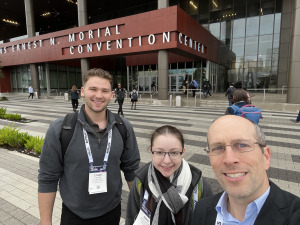
“The AGU fall meeting is a behemoth of a conference,” said Parsons, who worked with Beaulac and Chaco this summer in a NASA-funded research project related to ice ages on Mars and some enigmatic features found on the Martian surface. “At over 25,000 attendees from more than 100 countries, it is the world's largest gathering of Earth and space scientists. For Sara and Ethan, I'm sure it was an eye-opening experience to see the incredible breadth and depth of exploration and studies that are being undertaken. Nearly every aspect of Earth and planetary science is represented, including human-centered topics such as science education, environmental equity/justice, and climate policy. As young professionals, Sara and Ethan got a valuable window into the work of geoscience researchers and, not only get to see the work of others, but make personal connections and friends in the process.”
Chaco, of Townsend, said that it was an incredible honor to be surrounded by some of the most intelligent scientists in the world.
“I loved being able to lose myself in talks about the outer solar system objects, glaciers, hydrology, and any other geoscience related topic,” said Chaco, who is majoring in environmental and Earth science with a minor in geographic science and technology. “Being able to hear directly from researchers about upcoming publications before they are published was an incredible privilege.
“The overall feedback I received was positive,” said Chaco. “Many people were surprised that both Sara and I were undergraduate students, and I think that may have shaped the way they gave me feedback in some cases. The best feedback I got was less about my poster and more advice on completing a PhD or similar advice.”
Beaulac said that the range of people and scientists she saw at the conference was overwhelming, but everybody was there to explore different subjects and the graduate and post-graduate students and teachers were all welcoming and helped make the experience fun and enjoyable.
“I learned a lot from just looking around and watching what others were doing and talking with others as the week went by and got a lot of tips throughout the trip,” said Beaulac, a junior from Fitchburg who is majoring in environmental and earth science with a minor in geographic information systems.
Chaco’s presentation was on the constraints on past obliquity-driven climate scenarios on Mars by comparing ice flow modeling with observed glacial moraines using GIS.
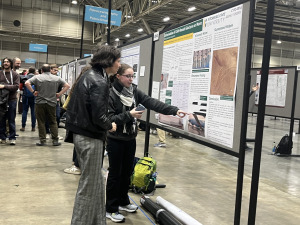
“Walking into the conference floor on the first day was an incredible experience,” said Chaco. “At first it was a little overwhelming as the poster hall was massive and it took a few minutes to walk from one end to the other. After the initial shock wore off however, the energy was amazing, I loved being able to walk around and look at all the incredible posters. When it was my turn to present I was pretty nervous, but being next to Dr. Parsons helped to keep my mind at ease. Everyone who came to my presentation was incredibly kind and asked some great questions. I was able to ask many post-grad students about their path and journeys.”
Beaulac presented on the deformation of cold-based glaciers on Mars by doing flow experiments with homemade slime.
“Some key takeaways from my presentation was that even knowing so little about Mars, both myself and others can improve just from past experience in research or things they have heard themselves,” said Beaulac. “One person even showed where we could further the experiment by changing the temperature. This experience helped me get more comfortable with presenting and figuring out how to show what I did in a way that most people would understand without having all of the research time that I did.”
Beaulac and Chaco each did a practice run last summer by presenting their research projects to a small group of faculty in a classroom at the Antonucci Science Complex, which served as a learning tool in preparation of their big days of presenting at the AGU Conference.
The students also dedicated countless hours of work in drafting their posters during a hectic time of the school year.
“It was near the end of the fall semester as they worked on their classes and completed final projects and exams early in order to attend the conference during finals week,” said Parsons. “They did their work without complaint, and were very excited to make the trip and get the most out of this unique experience. Having seen them work both in the classroom as their instructor and as an advisor on this research project, they both are exceptional students who have very bright futures in whatever discipline they choose to pursue.”
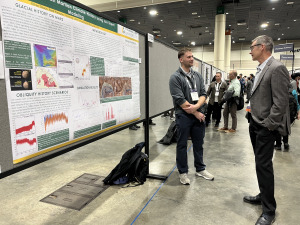
Parsons said that watching his students present was a very proud moment for him personally and for the department as a whole.
“To my knowledge, these are the first students from Fitchburg State to present at the fall AGU meeting,” said Parsons. “Their achievement came from months-long work over the summer doing research in the lab or on computer, conducting NASA-funded research addressing ice ages on Mars. It's a dream come true as an educator to share that level of scientific experience with these students.”
Parsons said that presenting at the AGU Conference will be a bright, shining badge on the resumes of his students when they apply for jobs or to graduate schools.
“Every researcher in the geosciences knows of AGU and understands the magnitude of the achievement of presenting there as an undergraduate,” said Parsons.
Parsons’ mentorship has meant a great deal to Chaco and Beaulac.
“I really appreciate (Parsons’) hands-off approach to guiding me through this internship,” said Chaco. “He was clear with the tasks he gave me and would answer any questions I had, but let me learn how to complete and document these tasks. He was very understanding and overall a great mentor, not just through this internship but through my entire time at Fitchburg State University. I remember back to my first class at Fitchburg State, Intro to Earth Systems Science with Dr. Parsons. He was my advisor then and he helped me fall in love with Earth Science. Never for a minute could I have imagined that I would be working with him for a summer. It was an incredible experience and I appreciate Dr. Parsons.”
To my knowledge, these are the first students from Fitchburg State to present at the fall AGU meeting. Their achievement came from months-long work over the summer doing research in the lab or on computer, conducting NASA-funded research addressing ice ages on Mars. It's a dream come true as an educator to share that level of scientific experience with these students.