


In the high-stakes world of international cybersecurity, there is a looming shadow known as "Q-Day." It is the theorized moment when quantum computers become powerful enough to shatter the encryption that protects everything from your bank account to national defense secrets. While global intelligence agencies scramble for solutions, savvy scholars at Fitchburg State University spent the last year building a bridge to the future of digital safety.
For students Rohanji “Anji” Novas and Charlie Stevenson, what began as a final project in a Linear Algebra course evolved into a journey that took them to Washington, D.C., for the Joint Mathematics Meetings (JMM)—the largest gathering of mathematicians on the planet. Their story is more than just a success in the lab; it is a testament to the power of big swings, the strength of the Fitchburg State community, and the personal resilience of two students who refused to let their backgrounds define their boundaries.
The story began in the classrooms of Percival Hall, where Assistant Professor of Mathematics Dr. Fernando Diaz Morera was challenging his students to see math not just as numbers on a page, but as a language for solving the world's most critical problems.
For Diaz Morera, Linear Algebra is the "ubiquitous subject"—the bridge between pure theory and high-impact applications like deep learning and coding theory. In his curriculum, students are required to produce formal written reports that mimic professional mathematical articles using LaTeX, the gold standard typesetting system for scientific documents.
"Anji and Charlie excelled at every stage," said Diaz Morera. "They were regular visitors to my office, stopping by to seek clarification, satisfy their curiosity, or simply enjoy a brief chat over a cup of café."
What sparked their specific interest in cryptography was a visit from Dr. Joseph H. Silverman, a world-renowned researcher from Brown University, who spoke at the Pi Mu Epsilon induction ceremony on campus. He spoke about lattice-based cryptography, a complex field of math that is currently the foundation for the new national standards in encryption. For Novas and Stevenson, it was a lightbulb moment. They realized that the abstract math they were learning in class was the very tool needed to fight the cybersecurity threats of the next decade.
To the average person, the terms "error-correcting codes" and "lattice-based cryptography" sound like a foreign language. However, Novas and Stevenson’s research focused on a fascinating paradox involving "noise."
In simple terms, cryptology is about protecting your messages from malicious eavesdroppers (thieves, hackers, spies) by locking it up so no one else can read it, while error-correcting codes (ECC) are about protecting messages from everyday disruptions—like static, bad Wi-Fi, or noise—by adding extra information so the message survives the bumpy ride.
The team’s research, titled "When Noise Protects and Destroys," explored how these two fields overlap. While ECC tries to remove noise to find the truth, modern cryptography actually introduces noise to hide the truth from hackers.
"Our current methods for keeping the internet safe rely on math problems that are just too hard for today's computers to solve," said Stevenson. "But quantum computers change the rules. Our research examines where these two areas intersect to create 'post-quantum' systems that remain safe even against the most powerful computers imaginable."
Many of our students balance rigorous academics with employment and family responsibilities. Yet, when provided with mentorship and research opportunities, they consistently exceed the highest expectations. This proves that excellence thrives at public regional universities.
As the project grew, so did the ambition. Encouraged by Diaz Morera, the students applied for—and won—the Falcon Scholars Undergraduate Research Assistance grant. This funding allowed them to transition from standard coursework to high-level research, meeting weekly to refine their exploration's goals and eventually their presentation.
"In our sessions, Charlie provides the snacks, Anji provides the joy, and I provide the smiles—along with a little bit of math," said Diaz Morera.
They spent hours coding concrete examples in SageMath, a powerful computer algebra system, to prove that their theories worked in practice.
However, a major hurdle appeared just weeks before the national conference in D.C. The cost of travel, lodging, and registration was significant, and the timeline to secure funding was shrinking.
Professor Mary Ann Barbato of the Mathematics Department took the lead.
"I originally approached Dean (Jannette) McMenamy about the funding, and she suggested I ask President (Donna) Hodge," said Barbato.
President Hodge didn't hesitate. She recognized the value of the students' work and immediately secured the funding.
"The way these students are connecting coding theory, lattices, and post-quantum cryptography is exactly the kind of ambitious, interdisciplinary research we want Fitchburg State to be known for," said President Hodge. "I am incredibly proud that they represented us at a conference of this scale."
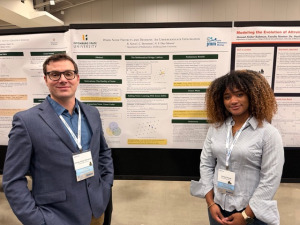
The Joint Mathematics Meetings in Washington, D.C., is an intimidating environment. It is a sea of thousands of professors, PhD candidates, and government researchers. For an undergraduate student, it can feel like being a small fish in a very large ocean.
"The morning leading up to presenting our poster was a mixed bag of anxiety and anticipation," said Stevenson. "The area was congested, and it was challenging to present in such close quarters with so many people coming and going."
But then, the world came to them.
Because their research focused on cryptography, they caught the attention of the National Security Agency (NSA). The NSA, which had a massive booth featuring a real WWII Enigma machine, sent recruiters to scout the student posters. When they saw the work Novas and Stevenson were doing on lattice-based encryption, their ears perked up. The students received a direct recruitment speech, highlighting a career pipeline that could take them from Fitchburg State to the highest levels of national intelligence.
The most meaningful moment, however, was a visit from Dr. Silverman—the very man whose talk on campus had started it all. Now the President-elect of the American Mathematical Society, Silverman took the time to visit the Fitchburg State booth, validate their progress, and engage with their findings.
"It felt like a true full-circle moment," said Stevenson. "Having a world-renowned researcher take the time to engage with undergraduate work proves that the math community is more inclusive than I once imagined."
While their research is impressive, the personal paths Novas and Stevenson took to get to Fitchburg State are even more compelling.
Novas’ journey began in Tamayo, a small town in the Dominican Republic. When she first moved to the United States, the challenges were immense. She didn't know English and struggled to keep up in school. The idea of becoming a researcher in computer science and mathematics seemed like a distant dream.
"There was a time when I was unsure of what the future would hold," said Novas. "Being here today is proof that every step I have taken—the sacrifices, the effort, and the determination—was worth it. When I look back now, I feel incredibly proud of how far I have come. This is exactly where I want to be."
For Novas, graduating in 2027 will be more than just receiving a diploma; it will be the fulfillment of a dream that crossed oceans and overcame language barriers.
Stevenson’s path was different, but no less determined. A veteran and a member of the Student Veterans Organization, Stevenson returned to Fitchburg State to complete his degree after nearly 20 years working in the IT industry.
"I used to think that mathematics was only for prodigies," said Stevenson. "But thanks to the care and dedication of the Fitchburg State University faculty, I’ve learned that it is actually a discipline built on persistence and collaboration."
For Stevenson, the education he is receiving at Fitchburg State allowed him to pivot from a long career in industry into the cutting edge of cybersecurity research. It proves a core Fitchburg State value: it is never too late to learn.
The success of Novas and Stevenson has sent ripples throughout the university. Diaz Morera sees this as a victory for educational justice.
"Many of our students balance rigorous academics with employment and family responsibilities," said Diaz Morera. "Yet, when provided with mentorship and research opportunities, they consistently exceed the highest expectations. This proves that excellence thrives at public regional universities."
The students are now carrying this momentum back to campus. Their goal for the current semester is to submit their research for formal publication in an academic journal. This is a rare achievement for undergraduates and would provide them with a massive advantage as they look toward graduate school and high-level careers in STEM.
As they look toward their upcoming graduation dates—Stevenson in May and Novas in 2027—they have become ambassadors for the potential of every Fitchburg State student.
"As Falcon scholars, I encourage other Fitchburg State students who have big ideas not to hesitate to pursue them," said Novas. "The faculty here genuinely care about our success and are always willing to support our ambitions."
The story of the 2026 JMM conference is now a part of Fitchburg State history. It represents the perfect alignment of student passion, faculty mentorship, and administrative support.
For Novas and Stevenson, the journey doesn't end in D.C. It continues every day in the classrooms, in the lines of code they write, and in the "noise" they are learning to master.
They aren't just students anymore; they are researchers, future innovators, and proof that at Fitchburg State, the world of mathematics is open to anyone with the determination to walk through the door.