


At her fourth-grade elementary school graduation, an eight-year-old girl stood before her peers, teachers, and family holding a hand-painted sign that boldly declared her ultimate dream: to become the President of the United States. Fascinated by the history of the White House, political leadership, and the power of public service, she devoured books from the Who Was? series, obsessed with the idea of making a difference through government.

Fast-forward through the years, and that same girl served as class president and president of the student government in high school, delivering her graduating class’s address.
Today, Christiane Camara Rodrigues Dias is a senior pre-law student at Fitchburg State University, a regional Moot Court champion, a 40-hour-a-week legal professional, and a proud first-generation college student.
When you ask Rodrigues Dias who she is, however, she will not begin by listing her honors or her GPA. Instead, she will tell you about the people whose sacrifices paved her way.
"It’s almost ironic that who I am today was never made up of just me," said Rodrigues Dias. "Instead, I am made up of the people who came before me. I am the first to walk these halls. The first to pursue a college degree in my family. The first to turn a dream that once seemed distant into something tangible. But I am not the first to sacrifice. Someone before me worked, struggled, sacrificed, and believed in a future they might not have been able to experience themselves. They became the foundation upon which I could become the first."
Across the nation, higher education institutions celebrate National First-Generation College Student Day to honor the courage and resilience of scholars who are the first in their families to pursue a four-year degree. At Fitchburg State, where first-generation students form a vital part of the campus fabric, Rodrigues Dias’ story exemplifies the sheer determination, profound pride, and immense weight that comes with being a trailblazer.
“Any person may encounter difficulties in navigating their degree, but it is the people who choose to rely on their life experiences, dedication, and the immutable belief that education changes lives who succeed,” said Fitchburg State Executive Director of Grant-funded Success Programs Elizabeth Swartz. “Today, we celebrate our students' commitment to their goals and honor the strengths of their accomplishments."
For many students, the road to college is mapped out years in advance by parents, older siblings, and family members who have already navigated admissions, financial aid, and campus culture. For first-generation students, however, the college application process often feels like traversing an uncharted wilderness without a map.
"One of my biggest challenges began before I even set foot on campus: applying to college," said Rodrigues Dias. "No one in my immediate family had ever gone through the college application process. I’m the oldest sibling, and I had no older siblings or family members who could walk me through the process based on their own experiences."
Left to navigate complex higher education bureaucracy independently, Rodrigues Dias spent her high school senior year calling and emailing Fitchburg State continuously—even throughout the summer—asking questions about applications, deadlines, and financial paperwork. At one point, complicated hurdles with the Free Application for Federal Student Aid (FAFSA) left her questioning whether college would even be possible.
Yet, every time she dialed a campus office, someone at Fitchburg State answered.
"I don’t remember the names of everyone who helped me during that time, but I remember what they did," said Rodrigues Dias. "Every time I reached out, there was someone willing to answer the phone, respond to an email, and help me figure out the next step. That support played a significant role in my decision to attend Fitchburg State. It made me feel like the university wanted me there and was invested in helping me succeed."
Once Rodrigues Dias arrived at Fitchburg State, the challenge shifted from getting into college to staying afloat amid a staggering workload. Today, as a full-time senior, she juggles her rigorous academic courses with a demanding 40-hour work week at an immigration law office, navigating complex legal cases in the real world while mastering legal theory in the classroom.
Balancing a grueling work schedule with full-time studies requires radical discipline, time management, and sacrifice. But whenever the long hours threaten to exhaust her, Christiane anchors herself in memories of her family's steadfast presence.
"One memory that has always stayed with me is sitting at our dining room table late at night, sometimes until midnight or 1 in the morning, working on assignments," said Rodrigues Dias. "My mom would sit across the room on the couch, waiting for me to finish so I wouldn’t be alone. She didn’t have to sit there, but she did. She wanted to be there with me, even if all she could do was keep me company while I studied."
When exams approached, her parents, Gelsely and Cristian Rodrigues, would step in, urging her to focus solely on her studies while bringing her favorite snacks and quietly taking care of everyday chores.
Now married to her high school sweetheart, Rodrigues Dias finds that same quiet devotion mirrored in her home today.
"My husband has become another enormous source of support," said Rodrigues Dias. "When I need to work late into the night, he’s there, sitting across from me on the couch while I work at the dining room table. The dining room table has become a symbol of my journey. A dining table represents family, togetherness, and communion, but for me, it also represents all the late nights I’ve spent studying and working, looking up to see my family across from me and remembering why I’m doing what I’m doing."
I have always been impressed with Christiane’s work ethic and drive to succeed. Her family is at the heart of everything she does, and making them proud matters deeply to her. As the first in her family to pursue a college degree, she is opening a door for those who come after her. I am proud to work with her as a student at Fitchburg State.
Rodrigues Dias’ fierce work ethic and analytical mind have paid dividends in one of the university’s most competitive academic arenas: moot court.
Under the mentorship of pre-law advisor and coach Dr. Paul Weizer, Rodrigues Dias and her peers spend countless hours analyzing landmark constitutional cases, crafting complex appellate briefs, and facing sharp, relentless questioning from practicing attorneys and judges.
“I have always been impressed with Christiane’s work ethic and drive to succeed,” said Weizer, who chairs the university’s Economics, History and Political Science Department. “Her family is at the heart of everything she does, and making them proud matters deeply to her. As the first in her family to pursue a college degree, she is opening a door for those who come after her. I am proud to work with her as a student at Fitchburg State.”
During the regional moot court tournament, all those late nights at the dining room table culminated in a defining victory. Rodrigues Dias and her partner, Amanda Deleon Guimaraes, swept through grueling rounds of legal argument to emerge as regional champions, earning national recognition for Fitchburg State.
"When we won regionals, I could hardly believe it," said Rodrigues Dias. "I was doing something I genuinely love: studying law, debating, constructing arguments, and advocating for a position. I was standing there, presenting an argument and using my voice in a way that I had dreamed about for years. I wasn’t just imagining a future in law or writing down my ambitions on paper — I was living them. That was when I realized that my dreams were becoming something tangible."
Beyond the legal arena, Rodrigues Dias’ time at Fitchburg State has been marked by service and leadership. Through a service learning class, she helped coordinate a gift drive and educational workshops for the local Boys & Girls Club, emphasizing that higher education is a tool for uplifting the broader community. Her academic excellence earned her induction into Alpha Alpha Alpha (Tri-Alpha), the national honor society recognizing the high achievements of first-generation college students.
Society often frames the first-generation college experience through the lens of hardship, disadvantage, or what students lack compared to their peers. Rodrigues Dias passionately rejects that deficit mindset. To her, being a first-gen student is a badge of supreme strength and adaptability.
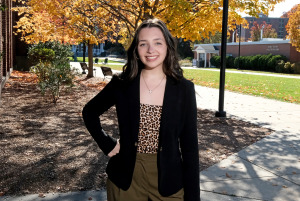
"I don’t believe being first-generation should be a label associated only with difficulty or disadvantage," said Rodrigues Dias. "It should also be a label associated with strength, resilience, determination, and pride. We shouldn’t have to wear that label as a reminder of what we lacked. We should be able to wear it as a reminder of what we overcame and what we are capable of achieving."
Rodrigues Dias points out that first-generation students possess a unique set of skills cultivated out of necessity: resourcefulness, independence, and the courage to advocate for themselves when navigating unfamiliar systems.
"First-generation students often have to figure out parts of that journey for themselves," said Rodrigues Dias. "That experience teaches you to be resourceful, adaptable, and persistent. It teaches you how to ask questions, seek out resources, and keep going even when you don’t have all the answers."
As Rodrigues Dias approaches graduation at just 20 years old, diploma in hand and a promising career in law waiting on the horizon, she remains grounded in the collective effort that made her journey possible.
"To me, being a first-generation student means that I am paving a path," said Rodrigues Dias. "I am the first one to walk these halls. I am the first one to earn a college diploma. But I am not the first one to dream these dreams. I am just the first one to live them out. When I receive my diploma, it won’t just represent my name. It will represent my family name, too. My parents’ name, my husband’s name, and the name of everyone who helped make this possible. They deserve to be on that diploma just as much as I do."
For incoming first-generation students who may feel intimidated or question whether they belong in the marble halls of higher education, Rodrigues Dias offers advice forged in her own trial and triumph:
"Give it all you have. Give it all you have, and then give a little more. And when you feel like you’ve given everything you have, lean on the support around you,” she said. “Don’t let the fact that you’re the first make you believe that you don’t belong. Being the first doesn’t mean you’re any less capable. Ask questions, make connections, and don’t be afraid to reach out.
"Give yourself grace as you learn," she added. "Keep showing up, keep asking questions, and keep believing in the person you’re becoming. You belong here. You deserve to be here. And you’ve got this."
Standing at the intersection of her childhood ambitions and a bright legal future, Rodrigues Dias proves that while being the first is a heavy responsibility, it is also an extraordinary honor—one that transforms individual dreams into a lasting legacy for generations to come.
Poem by Christiane Rodrigues:
(The poem is just the narration of what it feels like to be a first-generation student applying to college and navigating that experience)
It’s senior year of high school.
There's endless applications and questions to go through
I answered all the questions with ease and clarity -
But I STOP at the one asking about my parents’ education and degree.
Maybe this happened to both you and me,
For I don't think this experience was at all unique
But if at all there's someone in this room,
Who maybe didn't get to feel this too
I'll ask for just a couple minutes to walk you through.
Picture this, Its senior year of high school,
There’s so much running through your mind.
What school should you go to? You have to be the exception to the rule.
With what money? Will debt be forever?
What about scholarships - what can you find?
So, you open your laptop and start to dig the mine.
There’s standard questions, financial and more,
Personal sections I scroll through in line,
Watching as the completion percentages climb.
But there’s one question that touches an unknown part,
That stings, that burns every time:
“Do they hold a degree?” I pause on the line.
I read it once, I take it in,
A million thoughts cross my mind,
as I Think of all they were denied,
All the doors that stayed closed for them,
And for the ones who came before us,
I wonder if they knew the greatness they carried to reach such a purpose
I check off no to the question that was asked
But it's like I checked off ‘no' to “did they have a chance?”
And If they were given one, how much would they have advanced
And then it asks: are you first-generation?
And I sit there asking what does that mean and where does it begin?
To be the first to step somewhere someone's never been.
Like the first to fly across the sky,
Or the first to uncover what light can be—
I guess being first carries a weight, But also a lot of possibility.
And, if you're here today to be inducted,
That first begins with you.
That first is just getting started too.
Yes, You are first-generation student,
And it should make you burn with pride,
With hope, fierceness, determination, and fire inside.
We gather here today not just to celebrate,
But to recognize how far we’ve come,
Tri Alpha - A space where firsts become more than one.
An honor built on strength and drive,
On stories that refuse to fall,
And an achievement not just for ourselves, but for those before you who never had the call.
Because outside these walls, the world feels heavy,
History feels like it's always going to echo fear,
Where livery and justice for all doesn't feel so near.
And still, we rise, despite the noise,
Despite the doubt, despite the blame,
We pick up our pens and begin to make known our names.
Despite being told we may never make it,
That all “firsts” are destined to do is to trip and fall behind,
We stand tall and wide, to be the proof they were wrong this time.
We are the first to walk these halls,
The first to turn these dreams to plans,
The first to carry generations forward, with open minds and steady hands.
We come from places where chances were vast and if any few,
Where dreams were often had to be side aside,
We today can accomplish them, full of pride.
Darkness cannot drive out darkness,
Only light can take its place,
So we rise not just for ourselves, but to lift the whole human race.
Keep achieving, keep believing,
Keep pushing past the fear,
Honor those who came before you, by going further than they were near.
Let this be more than just an honor,
Let it be a guiding light,
A reminder that first-generation students are leaders ready for the fight.
It's not just about where or who you came from,
But about who you are now, and who you're working to become.
Today, we’re here. Today, we're one the way.
Today, we know we belong.
Tomorrow we're there. Tomorrow we've arrived.
And tomorrow we will carry our names, lifelong.
Now Picture this: it’s senior year of high school,
Not for you, but the ones that came after you.
They’re asked, “Do your parents hold a degree?”
They look at you… and check off yes, proudly.
Tri Alpha: Firsts who became ONE