


In healthcare education, realism is everything. A split-second delay in assessing a decline in vital signs, a misread electronic chart, or an unpracticed bedside conversation can make all the difference in patient outcomes.
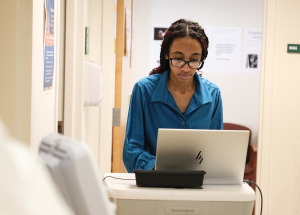
Inside the Simulation Laboratory at Fitchburg State University, nursing students step into high-fidelity hospital rooms designed to replicate these exact pressure-cooker scenarios —complete with responsive manikins, real-time diagnostic monitors, and dynamic clinical plotlines.
Yet behind the realistic hum of the monitors and the seamless execution of these critical scenarios isn't a seasoned medical doctor or a lifelong hospital administrator. It is Kennedy Gough ’25, a digital artist, programmer, and the university’s 2025 Game Design Student of the Year.
Now serving as the full-time Staff Assistant – Simulation Operations Specialist at Fitchburg State, Gough has bridged the gap between two seemingly distinct worlds: interactive game development and life-saving medical education. Her career has been shaped by the education and training she received through her coursework in Fitchburg State’s heralded Communications Media Department, and illustrates the skills and experiences she enjoyed transcend job descriptions.
"Kennedy's ability to cross disciplinary lines to solve real-world problems represents the skills being developed every day at Fitchburg State," University President Donna Hodge said. "By applying her talents in game design and immersive technology to healthcare, Kennedy is having an impact on how our nursing students learn, practice, and build life-saving confidence."
Beyond hosting the state’s first game design program at a public university, Fitchburg State’s Communications Media Department includes concentrations in digital media innovation, film and video production, graphic design, photography, and public relations, social media, and advertising production. Its graduates include award-winning filmmakers and practitioners who launch their careers following internships at sites across the U.S. and beyond.
Gough’s path to the health sciences was anything but conventional. As a student at Fitchburg State, she was initially drawn to the Game Design program by a dual passion for logic and artistry.
"What initially drew me to game design in general was my love for both tech and the arts," said Gough. "I loved to program and the critical thinking that came with that, but I am also a very creative person and love to draw and tell stories. Game design felt like the best way for me to incorporate everything that I loved — being able to build something that is both technical and beautiful."
The Game Design major in Fitchburg State’s Communications Media Department was the first such program at a public university in Massachusetts. Its coursework spans the department’s introductory classes on communication and media studies and incorporates computer science, writing and game design.
During her undergraduate career, Gough immersed herself fully in the university community. She sang with the Fitchburg State Choir, served as an academic tutor for her peers, and distinguished herself in game development courses like Game Concept Art and Game Narrative Design.
Her pride and joy as a student was as a programmer on Pteri & Clyde, an arcade game featured at Fitchburg State’s prestigious Visions exhibition in 2024.
As she progressed, Gough found herself specializing in programming to meet the needs of her project teams. By her senior year, her exceptional talent, work ethic, and versatility earned her the department's highest honor: 2025 Game Design Student of the Year.
Gough assumed her next step would naturally be a position at an indie game studio or a major tech corporation. But a conversation with Game Design Professor Jonathan Amakawa opened an unexpected door: an internship with the university's Nursing Department to help build extended and augmented reality (XR/AR) simulations.
"This transition was actually very unexpected," said Gough. "I had the standard plan in my head for what I wanted my future to look like. It was actually Professor Amakawa who came to me with the opportunity. I was apprehensive at first, fearing that the rigidity would feel creatively stifling, but I was intrigued since it was so different and I was interested in how much it could help people. I ultimately decided to take the leap."
Stepping into the nursing lab as an intern meant translating her technical knowledge into an entirely new medium. Fitchburg State had contracted with GigXR, a medical AR development company, to build augmented reality simulations using specialized headsets. When Gough joined the initiative, she was tasked with diving headfirst into an established, proprietary software framework.
"The biggest challenge was definitely learning how to use GigXR’s programming framework," said Gough. "It was already a struggle for me to pick up somebody else’s in-progress project, as I was used to starting programs from scratch that followed my own system. All of my prior knowledge had to be broken down into the fundamentals where I essentially translated it into the way GigXR’s programs worked."
Undeterred by the steep learning curve, Gough combed through technical documentation, collaborated with tech support, and conferred with former developers to master the architecture. When the department's relationship with the vendor ended, Gough didn't let the project stall. Instead, she took the reins independently, adapting and building custom simulations on new platforms to ensure nursing students continued to benefit from cutting-edge immersive learning.
It was during this period that the true weight of her craft dawned on her.
"My work with the nursing department has definitely broadened the way that I look at games and game design," said Gough. "I had always had an idea that games could be used educationally, but I had underestimated the impact that games like those could have on industries in the future. Once I was given the opportunity to explore those options for myself, I truly understood how much of an impact these tools can have on those learning important skills in the medical field."
Gough’s exceptional work as an intern made her an undeniable candidate when a full-time professional vacancy opened in the Simulation Lab. In May 2025, Fitchburg State officially hired Gough as Staff Assistant – Simulation Operations Specialist.
"We hired her based on her internship experience and how well she was able to connect what she'd learned in game design to nursing simulation — both in terms of the technology and the relationship between gaming and simulation," said Simulation Lab Director Ian Murray. "Her FSU education prepared her well to adapt to a new field."
My work with the nursing department has definitely broadened the way that I look at games and game design. I had always had an idea that games could be used educationally, but I had underestimated the impact that games like those could have on industries in the future. Once I was given the opportunity to explore those options for myself, I truly understood how much of an impact these tools can have on those learning important skills in the medical field.
Gough was immediately presented with a monumental task. Modern healthcare relies heavily on Electronic Medical Records (EMR) — digital charts where nurses track patient history, administer medications, and document vital signs. For years, the Nursing Department had sought to transition from paper records to an authentic digital platform. Previous efforts to partner with external hospital networks for software access had fallen through due to staffing constraints.
“Kennedy is a gem. This has already had a major impact on student learning,” said Associate Professor and Chair of the Nursing Department Deborah Benes. “It brings our medication administration competency to a higher level of learning that more closely simulates what students are doing in the hospital setting and prepares them for the workforce. We are really excited about her connection to game design and her desire to work with them, work with an intern and get our XR program back up and running to add another layer of learning for our students.”
When Murray identified an open-source option called Marsupial EMR, Gough stepped up to turn the vision into reality.
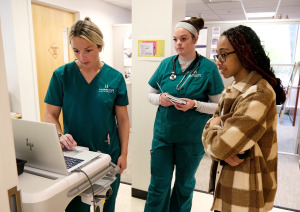
"Many parts of this role were completely new to me, but this task was something familiar since it was a software problem," said Gough. "The program was housed and distributed on GitHub, a platform I am very familiar with due to my work in game design, since it's what we used to share code on projects. I was comfortable getting the program set up, figuring out how it worked, and translating that into something accessible for the whole department."
Gough transcribed patient histories, medication orders, and clinical charts into Marsupial EMR. Thanks to her ingenuity, Fitchburg State nursing students are now using functional electronic medical records in their training simulations for the very first time — a massive leap forward in workforce readiness.
"Kennedy figured out how to get a freeware EMR to work for us and has transcribed many of our simulated patients' records," said Murray. "Students this year are using an electronic medical record for the first time. She’s been instrumental."
On any given day, the Fitchburg State Sim Lab is a hive of activity, and Gough’s role is as dynamic as it gets. On simulation days, her morning starts early alongside Murray, powering up high-tech patient manikins, preparing workstation computers, and checking the Marsupial EMR records to eliminate technical glitches.
Before scenarios begin, Gough leads brief tutorials for students who are using the digital charting system for the first time. During the simulation itself, she monitors the control room, providing technical support, adjusting software variables, and even lending her voice acting skills.
"I have started acting in the sims," said Gough. "While I get more comfortable, I have been doing limited roles, such as voicing patient family members."
On non-simulation days, Gough works behind the scenes to prepare room setups, reset medication supplies, calibrate manikins, and collaborate with IT to overhaul hardware and license new software across the lab.
Despite her heavy technical workload, Gough discovered that the artistic skills she honed in game design are just as critical in healthcare as her programming background. Creating a believable clinical simulation, she discovered, requires world-building and character storytelling.
"I was expecting that since the medical field is so technical and strict, there would be no room for imagination," said Gough. "To an extent that is true — I am not including the fantastical things that I used to. But there is a lot of creativity that goes into making the patients feel realistic and alive, from giving them a history and life beyond the hospital bed to reflecting that in the way the room looks and how the patient acts."
Gough attributes much of her rapid success to the supportive environment cultivated at Fitchburg State. She points to faculty members across disciplines who championed her development — from Game Design professors Amakawa and Sam Tobin to her leadership team in Nursing.
"Professor Amakawa was the one to offer me this internship and support me through it," said Gough. "Professor Sam Tobin offered me my first job in the game design department, served as my academic advisor, and showed me how much Fitchburg had to offer — telling me about the Visions competitions and game jams."
Amakawa said that Kennedy is the type of student who can do all the big things, important skills, and do them really well.
“She’s a talented artist and can make game art and game art assets,” said Amakawa. “She’s also a talented programmer. She’s one of these game developers that can do the whole package, especially with the nursing project.
“I’m incredibly proud and pleased to see this. It’s so satisfying,” he said. “I get to see her right at the beginning of the program, then progress, and then out in the field applying what she does and doing things beyond what I had imagined.”
When she transitioned to the Nursing Department full-time, Benes and Murray provided the mentorship she needed to thrive.
"Debbie was a strong supporter of me, a strong motivator for me as a student who was scared, helping me start feeling more confident in my skills and advocate for myself," said Gough. "And I am so appreciative of Ian Murray. I was very nervous starting this role, but Ian showed me the ins and outs of the job and has been patient and understanding. I have felt confident so quickly because he has been so supportive."
The feeling of gratitude is mutual. Murray views Gough as a transformative presence within the department whose contributions extend far beyond maintenance.
"Outside of her technical skills, Kennedy brings a positive attitude and new ideas to the simulation lab," said Murray. "For example, she plans to develop custom Bluetooth simulation devices, such as a simulated glucometer, for use in our lab. She also plans to continue working with game design faculty and students to continue developing virtual reality simulations. She is an excellent employee, and I think she will make contributions to the field of nursing simulation both inside and outside of FSU."
For Gough, coming full circle to work at her alma mater so soon after graduation is both an honor and a testament to Fitchburg State’s tight-knit campus culture.
"Fitchburg is a university that focuses on community for students, faculty, and staff alike," she says. "Small class sizes and the university’s general culture allow for close-knit relationships with professors and employers that make growth like mine possible. I am proud to be able to come full circle and provide that environment for the students here now."
When asked what advice she would offer to current students — particularly those in creative or technical fields like game design — Gough encourages them to look beyond traditional career boundaries and embrace unexpected opportunities.
"The path that you take to your future is much wider than you can see," said Gough. "Most students, especially in game design, are only looking at the most widely known jobs. But that is short-sighted. There are lots of strange and unorthodox jobs that are deeply meaningful and fulfilling.
"In this era, technology and secular fields are mixing and sharing their ideas, techniques, and skills," she said. "Many new and interesting careers are being born out of that sharing of culture. Don't put yourself in a box just because you think you should be doing one specific thing. It's a big, weird world out there."
As Fitchburg State University continues to prepare the next generation of healthcare professionals, Gough stands at the intersection of imagination and impact.
With new virtual reality concepts on the horizon and custom simulation hardware in development, her work ensures that Fitchburg State nursing students receive an education that is not only technologically advanced, but deeply human at its core.