

Diversity, Equity, and Inclusion
Diversity, Equity, and Inclusion Initiatives
Library Diversity, Equity, and Inclusion (DEI) Committee
Library DEI Committee Charge
Library Diversity, Equity, & Inclusion Plan
2025-2026 Library DEI Team Members: Olivia Rossetti (Chair), Meghan Kelly, Kim Smalley, Lori Steckervetz, and Connie Strittmatter
In a public response to the 2020 murders of George Floyd and Breonna Taylor, the Library issued a public statement of solidarity with the BLM protests and made a commitment to address systemic and institutional racism both within the Library and across campus. In order to ensure that the Library followed through on this commitment, the Library Anti-Racism Committee was created at the end of FY2020. The committee's make-up include both librarians and library staff.
In fall 2022, the committee's name was changed to the Diversity, Equity, and Inclusion Committee, and its charge was updated. The name change recognizes the intersectionality of oppressions, and our commitment to ending all systemic oppressions.
Over the course of FY21 the team developed a Library Diversity, Equity and Inclusion (DEI) plan. The Library DEI plan focuses on 5 areas of Library operations:
- Staff Professional Development
- Collections & Systems
- Programming & Outreach,
- Policies & Procedures
- Library User Data Gathering & Assessment.
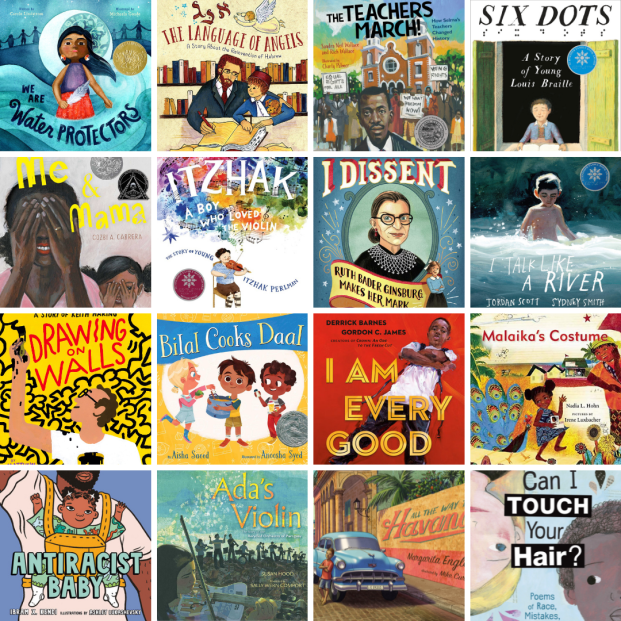
The Library began implementing the Library Diversity, Equity, & Inclusion Plan with a Children's Literature collection development pilot project. The goal was to identify and fill gaps in the existing collection to ensure that it included a diverse representation of topics and authors. This project resulted in the purchase of over 198 new titles to increase diverse representation in the Library’s picture book collection.
In spring 2023, the Library hosted a DEI facilitator to run a day-long training for all library staff. The session was funded through a 2022 Academic Innovation Fund grant. The goal of the session was to introduce and educate Library employees about implicit bias, cultural competencies, and microaggressions. The training will serve as a baseline for future professional development training that will look at how intersecting layers of oppression may be present in our daily library work.
DEI Focused Online Guides
The Library collaborated with a number of departments across campus to bring together multiple diversity, equity, and inclusion initiatives and support them with curated resources:
- Diversity, Equity and Inclusion - This guide serves as a landing page to link users to other the following: Anti-Racism resources and Understanding Land and Labor Acknowledgements.
- Understanding Land and Labor Acknowledgements - This guide provides information that supports the new practice of land and labor acknowledgements for campus events.
- Anti-Racism Guide - To help support the Fitchburg State community in learning more about systemic racism, as well as anti-racism practices and tools to enable the dismantling of racist systems, the Library has created and continues to update and expand an Anti-Racism Guide.
Project A+: Supporting Neurodiverse Students in the Library
Project A+ Team Members: Sherry Packard, Kim Smalley, and Connie Strittmatter
The Library's Project A+ team met regularly to investigate and develop new approaches to serving neurodiverse students. Using Florida State University’s Project A+: Serving Students with Autism Spectrum Disorder in the Academic Library as a guide, the team worked with library staff to make changes to the library environment to create a more inclusive environment that seeks to meet the needs of neurodiverse students.
Changes to the library space include:
- Additional lighting options - Rolling/moveable lamps and table lamps are now available throughout the library's 4 floors.
- Privacy panels - these simple cardboard table top screens are scattered throughout the Library. Students should feel free to move them to whatever table they want to use in order to help reduce distractions
- Movable standing desks - adjustable desks that can be moved anywhere in the library space so that students who prefer to stand while working can do so comfortably in the space of their choosing
- Quiet clocks - non-ticking wall clocks have been added to floors 2-4. If a student is sitting near the clock they will not be distracted by any ticking sounds, but may also find that it can be less distracting to glance at a clock instead of picking up a phone to check the time.
- Noise cancelling headphones - while the 3rd and 4th floors of the Library are designated as Quiet Study spaces, noise cancelling headphones can help students who are sensitive to ambient noises. Stop by the Front Desk by the Library entrance on the first floor to check out a pair.
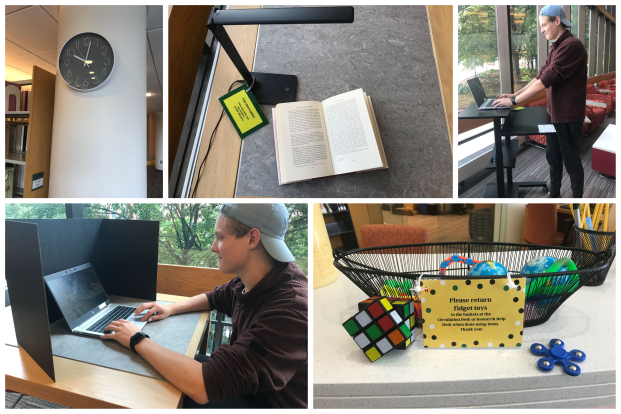
In addition to the environmental changes and tools, the Project A+ team also implemented an Alternative Communication Strategies training module which Library Student Employees. To evaluate the effectiveness of the training, the Project A+ team interviewed the student employees to solicit their feedback on what parts of the training were effective and areas that can be improved. The team is currently working on revisions to the training modules with Alternative Communication Strategies 2.0 Training.
Oral History Project: Building Representation for Underrepresented Voices
Oral History Project Members: Olivia Rossetti (project lead), Ahenebah Lane, and Asher Jackson
The Building Representation for Underrepresented Voices in the Archival Collections oral history project launched in FY2022 with the goal of creating an archival collection dedicated to documenting the experiences of students of color who attended Fitchburg State University. In collaboration with the Alumni Office and faculty, we performed outreach to past and current students to contribute to this pilot phase of the project. With a $2,000 award from the University Deans’ Anti-Racism Fund, the Library hired Ahenebah Lane, an independent public historian specializing in oral history, to conduct and transcribe the interviews.
By the end of the funding period, the team completed five oral histories–four with alumni, and one with a graduating senior. A second grant of $3,000 from the Deans' Anti-Racism Fund has allowed the project to continue into FY2023. It is essential to continue this work and provide prominent representation to students of color in our Archives, which we have historically lacked.